Nachhiring in Nepal

Photo Source:
Anonymous
|
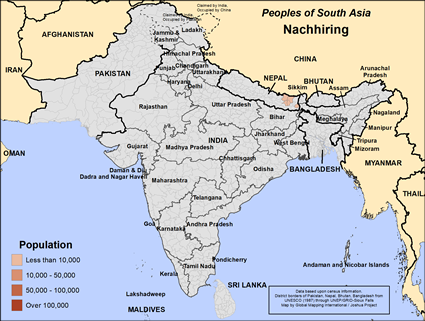
Map Source:
People Group data: Omid. Map geography: UNESCO / GMI. Map Design: Joshua Project
|
| People Name: | Nachhiring |
| Country: | Nepal |
| 10/40 Window: | Yes |
| Population: | 8,200 |
| World Population: | 8,200 |
| Primary Language: | Nachiring |
| Primary Religion: | Other / Small |
| Christian Adherents: | 0.00 % |
| Evangelicals: | 0.00 % |
| Scripture: | Translation Started |
| Ministry Resources: | No |
| Jesus Film: | No |
| Audio Recordings: | No |
| People Cluster: | South Asia - other |
| Affinity Bloc: | South Asian Peoples |
| Progress Level: |

|
Introduction / History
The Nachhiring are an indigenous ethnic group living mainly in the eastern hill districts of Nepal, especially in the Khotang District of Koshi Province. They are also known by alternate names such as Nachering, Nasring, Bangdel, and Nachiring Khas. The Nachhiring speak their own language, Nachhiring, which belongs to the Kiranti branch of the Tibeto-Burman language family. The language and ethnic identity are closely connected, and the community considers itself one distinct people group.
The Nachhiring are part of the broader Kirat cultural world of eastern Nepal. Traditionally, they lived in hill villages surrounded by forests and steep agricultural land. Their oral traditions trace their ancestry through clan lineages connected to important ancestral villages and sacred places in the region. Over generations, they maintained strong cultural traditions tied to agriculture, clan identity, and ancestral religion.
Today, the Nachhiring face growing pressure from migration, modernization, and language loss. Younger generations increasingly use Nepali more than their traditional language, and community leaders have expressed concern about preserving their linguistic and cultural heritage.
What Are Their Lives Like?
The Nachhiring have traditionally been agricultural people living in the eastern hills of Nepal. Farming remains central to life for many families, with crops such as rice, maize, millet, and wheat commonly cultivated. Animal husbandry is also important, including raising goats, buffalo, chickens, and other livestock. Some families are involved in trade, labor, or small business activities in nearby towns and cities.
Village life is strongly shaped by family and clan relationships. Extended families often remain closely connected, and respect for elders carries significant importance. Traditional homes are usually built in hill settlements where agriculture and community cooperation are necessary parts of daily life. Seasonal planting and harvest cycles continue to influence the rhythm of community activities.
Food commonly includes rice, millet, lentils, vegetables, and locally produced dairy or meat products. Community festivals, marriages, and religious ceremonies are major social events that reinforce family ties and cultural identity. Traditional dress, ornaments, music, and oral storytelling still hold cultural value in some villages.
Economic conditions vary. Some families have benefited from education, migration, or urban employment, while others face difficulties related to limited healthcare, educational access, transportation, and economic opportunity in remote hill regions.
What Are Their Beliefs?
The Nachhiring traditionally follow Kirat religious beliefs, though some also identify with Hinduism or Christianity. Their traditional religion includes reverence for ancestors, clan spirits, sacred natural places, and rituals connected to community identity and spiritual protection.
Like many Kirat peoples of eastern Nepal, the Nachhiring blend indigenous spiritual practices with elements of Hindu belief and local customs. Religious ceremonies may involve offerings, ritual specialists, ancestral observances, and ceremonies connected to agriculture, health, fertility, and protection from spiritual harm. Sacred hills and important ancestral locations continue to hold spiritual significance within their culture.
There is a Christian presence among some Nachhiring communities, but many still have little understanding of the biblical gospel and may mix Christianity with older religious traditions. Clear biblical teaching and discipleship remain important needs within the community.
What Are Their Needs?
The Nachhiring need faithful biblical discipleship, strong local churches, Scripture teaching in understandable language, and mature believers who can help ground new Christians firmly in God's Word. Where Christianity exists, there is still a need for deeper biblical understanding and spiritual growth.
They also face practical challenges including language preservation, educational limitations, healthcare access, transportation difficulties, and economic hardship in remote hill regions. Younger generations increasingly leave villages for work opportunities, which can weaken traditional community structures and language use.
There is a continuing need for compassionate Christian workers who can serve among the Nachhiring with humility, cultural understanding, and long-term commitment. Ministries involving literacy, education, medical assistance, and biblical training can help strengthen both communities and local believers.
Prayer Points
Pray that the Nachhiring people will grow in a clear biblical understanding of the gospel and place their faith fully in Jesus Christ.
Pray that God will strengthen existing believers among the Nachhiring to become spiritually mature disciples who faithfully share the gospel with neighboring peoples.
Pray that the Nachhiring people will be adopted through the People Group Adoption program so that ongoing prayer and future gospel engagement will continue among them.
Pray that God will preserve opportunities for Scripture translation, discipleship, and gospel ministry among the Nachhiring as their language and culture face increasing outside pressures.