Devadiga Kalavant in India

Send Joshua Project a photo
of this people group. |
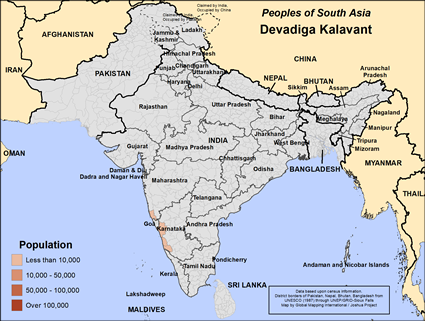
Map Source:
People Group data: Omid. Map geography: UNESCO / GMI. Map Design: Joshua Project
|
| People Name: | Devadiga Kalavant |
| Country: | India |
| 10/40 Window: | Yes |
| Population: | 7,600 |
| World Population: | 7,600 |
| Primary Language: | Konkani |
| Primary Religion: | Hinduism |
| Christian Adherents: | 0.00 % |
| Evangelicals: | 0.00 % |
| Scripture: | Complete Bible |
| Ministry Resources: | Yes |
| Jesus Film: | Yes |
| Audio Recordings: | Yes |
| People Cluster: | South Asia Dalit - other |
| Affinity Bloc: | South Asian Peoples |
| Progress Level: |

|
Introduction / History
The Devadiga Kalavant community is primarily found along the coastal regions of Karnataka and parts of Kerala in southern India. The Devadiga Kalavant people also go by the names Devadiga or Devadiga Gowda. They live primarily in India's states of Karnataka, Maharashtra, Telangana, and Andhra Pradesh. Most of the population live within the Karnataka state.
Historically, the Devadiga Kalavant have been associated with temple service, particularly as musicians, dancers, and performers in Hindu religious ceremonies. Their name itself reflects this heritage: "Devadiga" means "servant of God," and "Kalavant" refers to an artist or performer. Over generations, they have played a vital role in preserving and transmitting the rich musical and cultural traditions of the region, often serving in temples and at community festivals.
Their primary language is Konkani; secondary languages are Tulu, Marathi, Kannada, and Konkani Goan, depending on their locality.
What Are Their Lives Like?
Life for the Devadiga Kalavant centers around family, community, and the arts. Families are typically close-knit, with elders holding a respected place in guiding both cultural and practical matters. The Devadiga Kalavant people have always been farmers, traders, and businessmen. They have their own customs and traditions.
Many members of the community continue to be involved in music, dance, and other performing arts, though economic changes have led some to seek livelihoods in agriculture, small businesses, or urban employment. Community life is vibrant, with festivals and temple events providing opportunities for performance, worship, and social gathering. The annual temple festivals are occasions of great significance, marked by elaborate rituals, music, and dance that bring the community together. Despite the challenges of modernization and shifting economic realities, the Devadiga Kalavant remain proud of their artistic heritage and strive to pass it on to younger generations.
What Are Their Beliefs?
The Devadiga Kalavant people practice Hinduism, the ancient religion of India. Their religious life is deeply intertwined with temple worship and the performance of sacred music and dance. Hindus worship and serve the gods of the Hindu pantheon. They visit Hindu temples and offer prayers and participate in rituals, festivals, and offerings as expressions of devotion.to their gods in hopes of gaining protection and benefits. They do not have a personal or familial relationship with their gods like Christians or Jews. Many also hold beliefs in spiritual forces and ancestral spirits, seeking blessing and protection through both formal worship and folk practices. These traditions reflect a heartfelt desire for connection with the divine and for guidance in daily life.
Almost all Hindus participate in yearly celebrations like Holi, the festival of colors and the start of spring / Diwali, the festival of lights / Navratri, the celebration of autumn / and Rama Navami, Rama's birthday.
What Are Their Needs?
The Devadiga Kalavant community faces a range of physical and spiritual needs. Economically, many struggle with limited opportunities, especially as traditional roles in temple service and the arts become less sustainable in a rapidly changing society. Access to quality education, healthcare, and vocational training would greatly benefit their families and open doors to new possibilities. Socially, the community values unity and mutual support, but younger generations sometimes face pressure to leave behind their cultural heritage in pursuit of modern careers. The Devadiga Kalavant people need to be able to learn how to deal with the forces of modernization and globalization. The old ways of doing things often fail them.
Prayer Points
Pray that the Lord to inspire an individual or group to commit to the spiritual adoption of the Devadiga Kalavant people through the People Group Adoption program, to promote their access to the teachings of Jesus Christ.
Pray that the Lord would inspire loving, compassionate believers to share the gospel of Jesus Christ with the Devadiga Kalavant community in culturally meaningful ways.
Pray that the Holy Spirit would create an unquenchable thirst for God in the lives of the Devadiga Kalavant people, compelling them to pursue salvation in Jesus no matter the obstacles.
Pray that the Devadiga Kalavant people will be blessed with quality educational resources, reliable healthcare, and meaningful work. Through these blessings, pray that they will not deny his absolute power and goodness.