People-in-Country Profile
Peoples Data Filter:
Printer friendly version:
Step 1 - Select a Country:  
Send us your updates!
Can you provide any of the following for this people?
Step 2 - Select a People:
Bulang, Blang of China
Bulang, Blang People Photo
View Bulang, Blang in all countries.
Submit People Photo:
Peoples
               
Geographic
Global
               
Global
           
 
Affinity Bloc
           
Global


People Cluster
       
Region


People
   
Country


People-by-Country (Profile)


Religion
Language


Global
   
Language


Religion
                             
Bulang, Blang of China
 
Profile Text
Submit Profile Text:
Identity
Several smaller ethnolinguistic people groups have been combined by the Chinese to form the official Bulang nationality in China. Other peoples include the Angku, Puman, Kong Ge, and Samtao tribal groups.

Language
The Bulang language has great linguistic variety. One survey found as many as ten dialects spoken in just one Bulang refugee village in Thailand. Only 24,000 (29%) people counted under the Bulang nationality in China can actually speak Bulang; 30,000 (36%) speak Lawa. Two different Roman orthographies exist for the Bulang in China: one is called to-tham and is used by the Bulang in Xishuangbanna; the other, to-lek, is used in the region between Dehong and Lincang.

History
The Bulang traditionally lived in small clans, according to ancestral affiliations. Each clan possessed its own land and each member of the clan was responsible to work and harvest the crops. If a family moved away from the area, it forfeited its right to own land or reap the benefits from the produce. Each Bulang village has its own cemetery where the dead of each family line are buried. The corpses of those who die from unnatural circumstances are cremated.

Customs
Bulang are renowned as friendly people. The older women love to chew betel nut, which they spit out into the dirt in copious quantities. Betel nut stains their teeth black; this is considered a mark of beauty among the Bulang.

Religion
For centuries the Bulang have been ardent followers of Theravada Buddhism. Most of their villages are located alongside Tai people, who adhere to the same religion. Temples and idols are located throughout their communities. Many Bulang men enter the Buddhist monkhood, which brings great honor to their families. Few Bulang have ever heard of Christ, and few care to seek for anything beyond what they already believe. They strive to observe the Buddhist Tripitika (Three Baskets) teaching: practicing selfdiscipline, preaching, and discussing doctrine. The Bulang believe that right thinking, sacrifices, and self-denial will enable the soul to reach nirvana, a state of eternal bliss.

Christianity
The few evangelistic efforts that have targeted the Bulang have usually been discontinued by mission groups who invariably found a much more willing reception to their message from other groups in the area. Protestant work among the Bulang prior to 1949 resulted in 30 families being converted. Most of them gave up their faith during the oppressive Cultural Revolution, but there are about 50 Bulang Christians remaining in China today. Bulang translation work has begun in Thailand, but the Bulang in China will not be able to understand the script.

View Bulang, Blang in all countries.

 
Prayer Links Submit Links:
PrayerGuard.net
 
Web Profile Links Submit Links:
www.everyculture.com/Russia-Eurasia-China/index.html
asiaharvest.org/pages/profiles/nonChina/Myanmar/Bu...
asiaharvest.org/pages/profiles/nonChina/Myanmar/Ta...
en.wikipedia.org/wiki/Bulang
www.asiaharvest.org
www.china.org.cn/e-groups/shaoshu/index.htm
www.chinagate.com.cn/english/11.htm
www.chsource.org/Profiles.htm
www.kepu.ac.cn/english/nationalitysw/bla/index.htm...
www.paulnoll.com/China/Minorities/China-Nationalit...
www.thailandsworld.com/index.cfm?p=105
 
Web Resource Links Submit Links:
Audio RecordingsMegaVoice Audio Bible and Stories
Audio RecordingsGlobal Recordings

 
Maps
Submit Map:
Ethnolinguistic Map:
University of Texas map collection
Linguistic Map:
Ethnologue language map
  
  Submit Update:
Country: China
Continent:
Asia
Region:
Northeast Asia
Country Persecution Rank:12 (Only top 50 ranked, 1 = highest persecution ranking)
Yes
Country Details: World Factbook
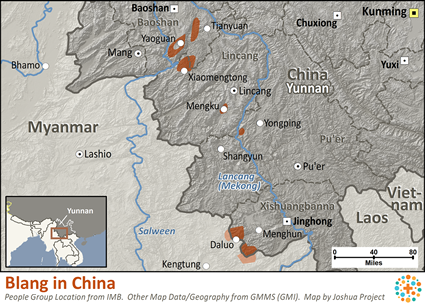
Location within Country:Approximately 80,000 Bulang live in southwest China. An additional 1,200 live in Thailand, and between 1,000 and 2,000 in Myanmar. The Bulang live in villages high up on thickly forested mountain slopes. They are located in several counties in Yunnan Province, especially Menghai and Shuangjiang. The Bulang in Thailand call themselves Khon Doi which means "mountain people."
(Source: Operation China, 2000)
   
 
People
Submit Update:
People Name in Country: Bulang, Blang
People Name General:
Bulang, Blang
Alternate People Names:
BangBlang
BraangBrang
BulangCol
HkawaK'wa
KalaKawa
Khon DoiKkawa
KontoiPlaang
PlangProng
People Code: 104959
Population in this Country: 96,000
Population in all Countries: 111,000
Yes
   
 
Southeast Asian Peoples
Mon-Khmer
People Name General:
Bulang, Blang
AUG03z
Ethnic Relationships:
Affinity Bloc -> People Cluster -> Peoples Ethnicity Tree
   
 
Language
Submit Update:
Primary Language:
Blang
Language Code (16th): blr    Ethnologue Listing
BLR
Primary Dialect:
Phang
Dialect Code:
blr01
Secondary Languages:
Samtao (Unknown)
Total Languages Spoken:
2
   
 
Religion
Submit Update:
Primary Religion:
Buddhism
Religion Sub-division:Theravada
Major Religions:
Buddhism90.00 % 
Christianity0.06 %(Evangelical: 0.06 %)
Ethnic Religions9.94 % 
Hinduism0.00 % 
Islam0.00 % 
Non-Religious0.00 % 
Other / Small0.00 % 
Unknown0.00 % 
Christianity Segments:
Anglican0.00 %
Independent100.00 %
Protestant0.00 %
Orthodox0.00 %
Other Christian0.00 %
Roman Catholic0.00 %
 
(Evangelicals distributed across Christianity segments)
   
 
Joshua Project Progress Indicators
Yes
Progress Scale: 1.2     Evangelicals >.01% but <=2%. Christian Adherents <=5%.
Need-Ranking Score: 71        Details
   
 
Other Progress Indicators *
Global Evangelical Status:Level 2   Less than 2% Evangelical. Initial (localized) church planting within past 2 years
Agency Progress (API):Level 3   Multiple agencies involved
Church Progress (CPI):Level 3   Group of churches
 
 
Bible Translation Status
Submit Update:
Bible Portions: Help start a Bible Translation
New Testament: None Reported
Complete Bible: None Reported
 
 
Ministry Activity
Register Ministry Activity:
Description: Register your ministry activity among this people group. Contact the Adopt-A-People Clearinghouse to learn about others that might be focused on this people group.
 
Bulang, Blang of China
* Notes:
  • Significant effort is made to match photos with people groups. In most cases the photo source has identified the people group. However, in some instances when the exact people group is not identified Joshua Project has made educated attempts at matching. As a result some photos may be representative of the people cluster rather than the specific people group. Mismatches are the fault of Joshua Project, not the photographer. Please contact us if you believe a photo is not matched with the correct people group.
  • Percentages may be printed as '0.00%' because of space limitations, but some are slightly greater than zero.
  • The exactness of the above numbers can be misleading. Numbers can vary by several percentage points or more.
  • People group population figures are now maintained as a percentage of the national population. Click here for details.
  • Joshua Project does not have specific ministry activity data supporting the "Other Progress Indicators."
  • Discrepancies may exist between "Other Progress Indicators" because of the varying sources of information.
  • Joshua Project does not know the exact content of web audio recordings. In general they are Bible reading and teaching.
  • As on-site realities are understood, barriers of acceptance may be found in many of the larger people groups that will require multiple distinct church planting efforts.
  • This data may contain errors and needs continual correcting and updating. Click here to send feedback.