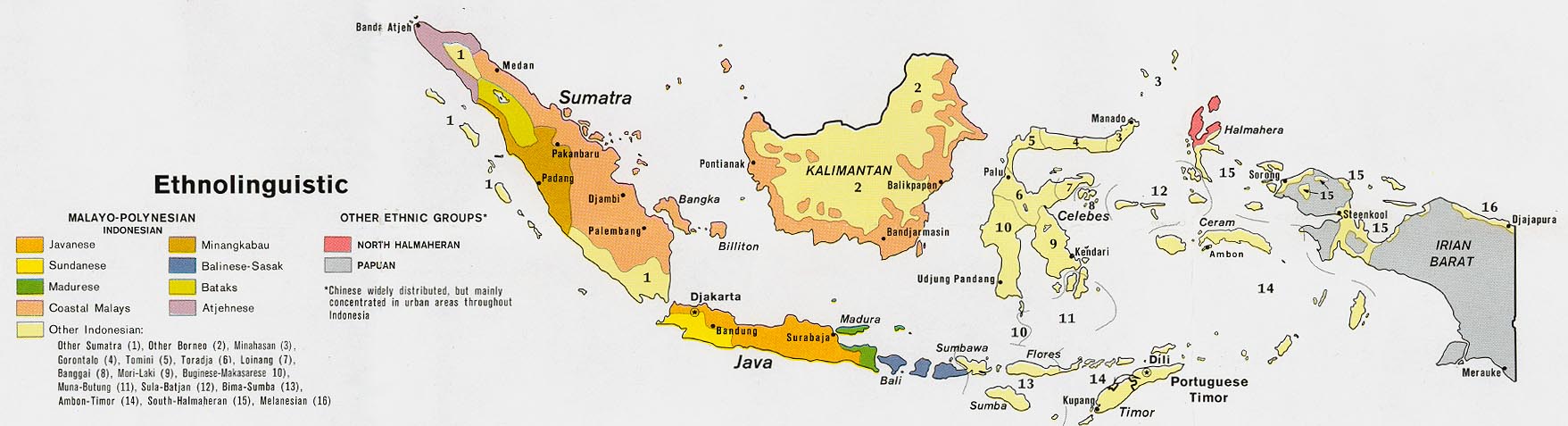
The Kaburi people live in the Papua Barat Province of Indonesia, mainly in Sorong Selatan and Teluk Bintuni regencies. Their villages are located inland from Maccluer Bay along the lower Kamundan River. They speak the Kaburi language, which belongs to the Trans–New Guinea language family.
Historically, the Kaburi have lived in remote forested areas, relying on hunting, fishing, and small-scale gardening. Their isolation has preserved traditional customs, though contact with other groups and limited development has begun to change their way of life.
Kaburi families live in small villages surrounded by dense rainforest. Houses are simple, built from wood and thatch, and clustered near rivers for water and fishing. Men hunt wild pigs and fish, while women gather sago and tend gardens that produce taro, sweet potatoes, and bananas. Pigs are highly valued for food and social exchange. Life is communal, and extended families often share resources. Celebrations include feasts where roasted pig and sago are served, accompanied by traditional songs and dances. Modern conveniences are rare, and most travel is on foot through rugged terrain.
According to Joshua Project, the Kaburi people identify primarily with Christianity, especially Protestant traditions. While many claim to follow Christ, there is a need for spiritual renewal and deeper commitment to biblical faith. Some traditional practices and cultural rituals continue alongside Christian forms, showing the importance of clear gospel teaching and discipleship.
The Kaburi face significant physical and spiritual challenges. Access to healthcare and education is extremely limited, and preventable diseases are common. Clean water and sanitation remain concerns, and economic opportunities are scarce. Spiritually, there is a need for strong local leaders and faithful teaching of God's word so that faith in Christ becomes life-changing. Believers need encouragement to grow and to join in God's mission to bless all nations.
Pray that the Kaburi will understand and embrace the truth of Jesus Christ as Lord and Savior.
Pray that those who profess faith will grow in grace and become part of the global discipleship force.
Pray for strong local leaders who will teach God's Word faithfully and lead with humility.
Pray for improved access to healthcare and education so families can thrive physically and spiritually.
Pray that cultural traditions will be preserved in ways that honor God and reflect His goodness.
Scripture Prayers for the Kaburi in Indonesia.
Ethnologue: Kaburi Language
| Profile Source: Joshua Project |