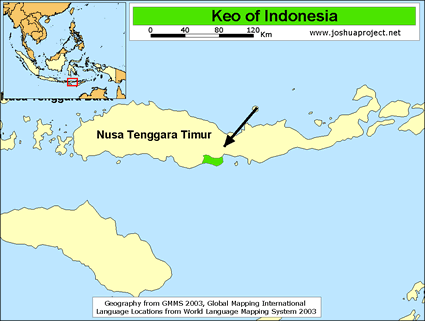

The Keo people form a distinct Austronesian ethnic group residing in the central-southern highlands of Flores Island, within Nagekeo Regency in East Nusa Tenggara Province, Indonesia. They inhabit the rugged southern slopes of Mount Ebulobo, spanning areas such as Boawae, Mauponggo, Mount Koto, Keo Tengah, and Kedi Diru, where volcanic soils and terraced landscapes have sustained their communities for generations. The Keo speak the Keo language, part of the Central Flores dialect chain that includes closely related tongues like Ngadha and Nage, reflecting ancient migrations across the island's mountainous terrain.
Historical records trace their name back to the 16th century, when Portuguese Dominican missionaries first encountered Keo villages in regions like Kewa, Mari, and Lena, long before widespread colonial influence. Dutch administration arrived late, in 1907, initially lumping Keo territories with neighboring Nage under shared cultural and linguistic ties, though Keo leaders fiercely maintained their autonomy amid efforts to unify the districts.
Keo families cluster in traditional villages perched on steep hillsides, where life pulses with the rhythms of wet-rice farming on meticulously carved terraces that hug the contours of the volcanic landscape. Men and women collaborate in planting and harvesting rice, while coffee and clove plantations provide modest cash crops amid the misty highlands. Homes rise as sturdy, thatched-roofed structures called uma, often elevated on stilts and adorned with symbolic carvings that echo clan histories and ancestral bonds. Social ties revolve around extended families and marriage alliances that weave a web of reciprocity, celebrated through vibrant rituals involving song, dance, and the clink of palm wine cups during feasts. Though younger generations increasingly seek education and jobs in nearby towns like Ende or Maumere, the Keo cherish their oral traditions, gathering under starlit skies to recount myths that bind them to the land's sacred groves and flowing rivers.
About two-thirds of the Keos are Muslim, and almost all the rest adhere to traditional religion.
Erosion gnaws at the ancient rice terraces that anchor Keo farming, demanding urgent conservation to safeguard food supplies against heavier rains and shifting soils. Limited roads wind through the highlands, hindering access to markets where coffee and cloves could fetch good prices, trapping families in cycles of subsistence.
Healthcare clinics stand few and far between, leaving vulnerable elders and children exposed to tropical fevers and unnecessary deaths. Education beckons as a pathway out of isolation, yet schools lack resources to nurture young minds.
Deepest of all, many Keo long for a transformative encounter with the gospel that pierces the veil of ritual and tradition, igniting house churches where families disciple one another and send forth laborers to unreached pockets across Flores and beyond.
Pray for Keo elders to have dreams and visions of the Risen and Victorious Christ, causing them to reconsider their spiritual lives.
Pray for the Lord to provide them with a record high harvest as proof of his goodness and power.
Pray for loving and dedicated workers to go to the Keos.
Scripture Prayers for the Keo in Indonesia.
Ethnologue: Languages of the World, 26th edition (Keo entry).
Tule, Philipus. Longing for the House of God, Dwelling in the House of the Ancestors: Local Belief, Christianity, and Islam among the Kéo of Central Flores. 2006.
| Profile Source: Joshua Project |