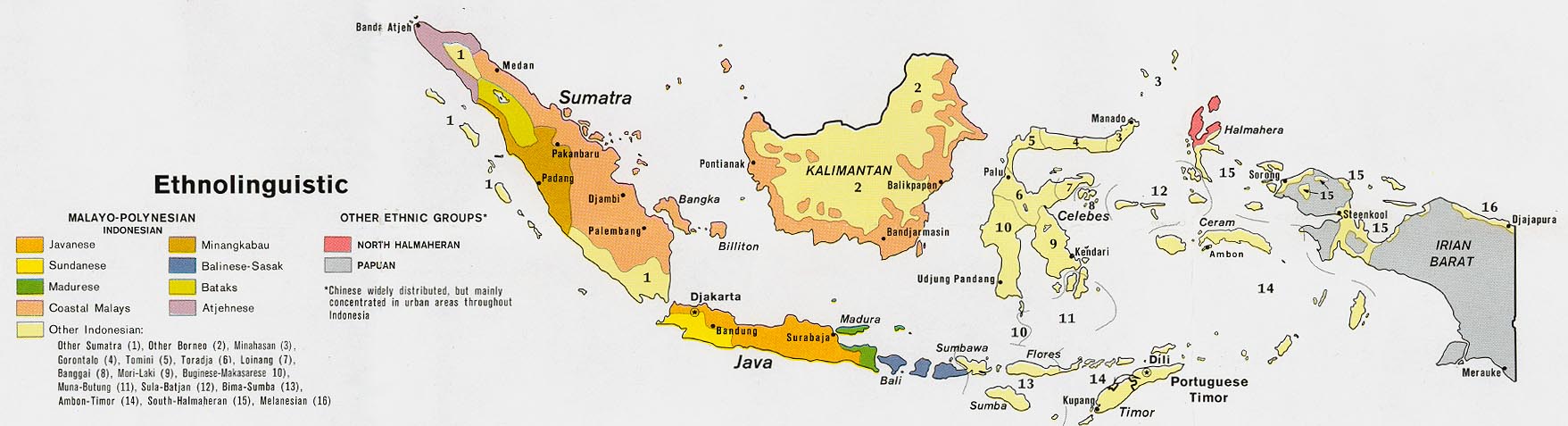
The Roon are a small Austronesian people group living on Roon Island and several villages along the southern shore of the Cenderawasih Bay (Geelvink Bay) in Teluk Wondama Regency, West Papua province, Indonesia. Their primary villages include Yende, Niab, Inday, Sariay, Syabes, and Mena. They speak the Roon language, which belongs to the Cenderawasih Bay branch of the South Halmahera-West New Guinea languages within the Austronesian family. The Roon maintain a distinct identity shaped by their isolated island and coastal environment, setting them apart from the larger Biak-Numfor and Wandamen peoples nearby.
Historically, the Roon lived in small maritime clans that depended on the sea for sustenance and trade. Pre-colonial life centered on fishing, sago gathering, and oral traditions tied to ancestral spirits and the ocean. Islam arrived gradually through contact with Biak traders and Tidorese sultanate influence in the 17th–19th centuries, while Dutch colonial administration and missionary activity in the early 20th century introduced Christianity to parts of the bay.
The Roon sustain themselves primarily through fishing, sago harvesting, and small-scale gardening in the mangrove-lined coasts and interior of Roon Island. Men venture out in dugout canoes or small motorboats to fish for tuna, trevally, and reef species using nets, lines, and spears, while women and children gather shellfish, crabs, and sago from the swampy forests that dominate the low-lying terrain. Families also cultivate coconut palms, bananas, cassava, and sweet potatoes on limited dry land, with copra production providing occasional cash income.
Family dynamics remain strongly extended and clan-based, with households often consisting of multiple generations living in wooden stilt houses roofed with sago leaf thatch, clustered along the shoreline for easy sea access. Elders hold authority in decision-making, marriage arrangements (which involve bridewealth of pigs, cloth, or boats), and passing down navigation knowledge. Celebrations include Islamic holidays such as Eid al-Fitr with communal prayers, feasting, and boat races, as well as traditional events like weddings featuring traditional dances accompanied by tifa drums and life-cycle rituals marking births or circumcisions. Food is simple and sea-oriented: sago porridge or grilled sago patties served with fresh or smoked fish, coconut milk, cassava leaves, and chilies, eaten together on woven mats to reinforce family and village unity.
Today, the Roon blend indigenous customs with formal religion in one of Indonesia's most remote corners. Some follow Sunni Islam, with faith expressed through daily prayers, mosque attendance in villages that have one, fasting during Ramadan, and observance of major Islamic feasts. Most can be described as adherents to traditional religion, including respect for sea spirits and ancestral guardians that influence fishing success or protection from storms, viewed through an Islamic understanding of Allah's ultimate control over creation.
Isolation on Roon Island and scattered mainland villages makes access to secondary education, vocational training, and quality healthcare extremely difficult, with most children ending formal schooling after primary level and medical evacuations requiring long boat journeys. Economic opportunities remain limited beyond subsistence, leaving families vulnerable to fluctuating fish catches, rising sea levels that erode coastal land, and storms that damage homes and boats. The Roon language is shifting rapidly among the younger generation toward Biak, Numfor, or Indonesian, endangering cultural heritage and limiting engagement with Scripture in the heart language. Spiritually, the Roon have almost no access to the Gospel in a culturally relevant form, with no full Bible translation available and very few known believers to share the hope of salvation through Jesus Christ.
Pray for God to call and equip faithful workers who love remote coastal peoples to live among the Roon, learning their language and ways in order to proclaim the good news with clarity and power.
Pray for God to accelerate Bible translation and the production of audio Scriptures, the JESUS Film, and oral stories in the Roon language so that entire families can hear and respond to God's word.
Pray for the strengthening and protection of any secret believers, giving them courage to gather and multiply house fellowships across the villages.
Pray for safe boats, sustainable fishing methods, clinics, schools, and clean water for these people.
Pray for God to guard Roon youth from despair or migration without purpose and raise up a generation that knows Christ deeply and carries his light to neighboring islands.
Pray for the Roon to become a joyful worshipping people who send out their own missionaries throughout Indonesia.
Scripture Prayers for the Roon in Indonesia.
Ethnologue (SIL International): Roon language entry
Linguistic classifications of Cenderawasih Bay languages (Austronesian, South Halmahera-West New Guinea).
Ethnographic reports on coastal peoples of Teluk Wondama Regency, West Papua.
| Profile Source: Joshua Project |