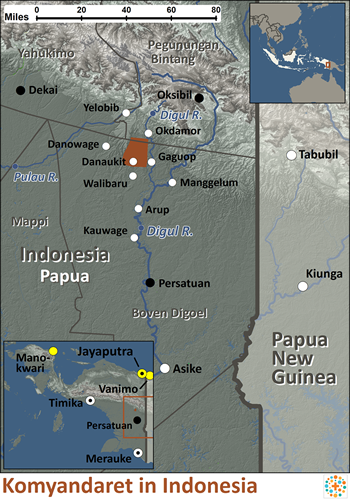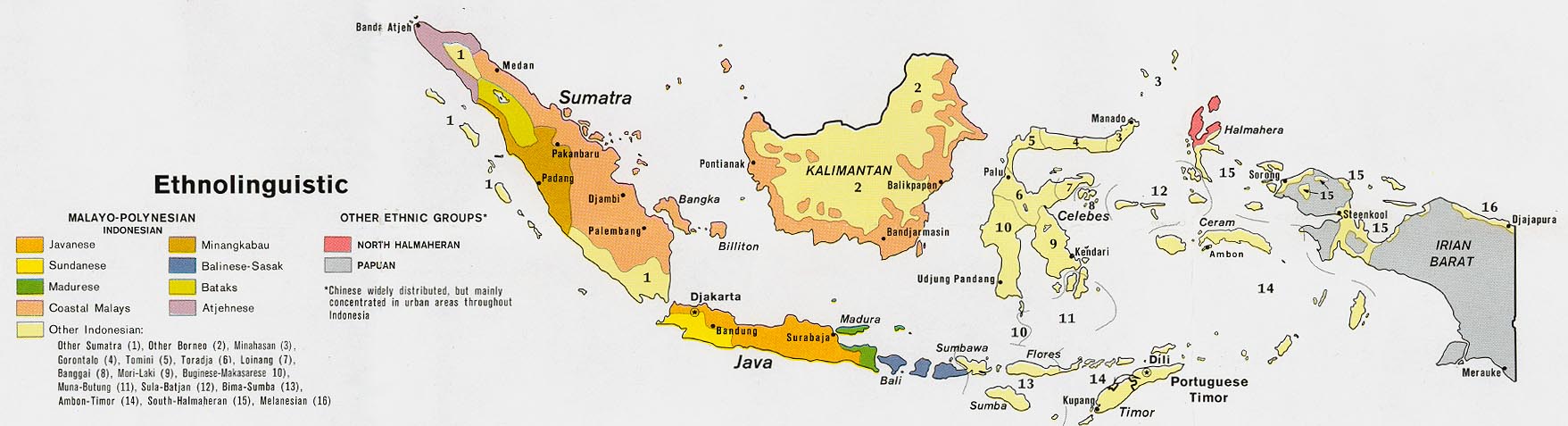
The Komyandaret are a small indigenous people group living in the remote interior of South Papua (modern Indonesia), primarily in the headwaters region of the Digul River in the western bank of Boven Digoel Regency.
Their primary language is Komyandaret, which belongs to the Trans–New Guinea family.
Because of their small population and remote location, the Komyandaret are little?documented in published literature and have only limited contact with outsiders.
Given their location in the forested interior of South Papua, the Komyandaret likely live in a traditional subsistence mode, similar to other small forest peoples in the Digul River basin. While detailed ethnographic description is lacking, their geographic region is very remote: Boven Digoel Regency is sparsely populated, with limited infrastructure.
Transportation, roads, and access tend to be difficult in much of South Papua, especially in interior areas — many river?basin communities depend on rivers, small airstrips or footpaths rather than highways.
Their daily life likely revolves around forest resources, river fishing or gathering, hunting, and possibly sago or other natural staples — as is common among neighboring small river?basin peoples. (Their linguistic relatives in the region, such as those speaking languages in the same block, follow such subsistence patterns.)
Because of the isolation and small size, there is likely very limited access to modern services — schools, healthcare, or outside economic systems — though specific data for Komyandaret is not available in public sources.
They are ethnic religionists. Reported Christian presence among them is extremely minimal.
No known JESUS Film, audio recordings, or other modern evangelical resources are listed for their language group as of now. Because there is virtually no church presence, the spiritual worldview of the Komyandaret likely remains rooted in their ancestral beliefs, with traditional practices, rituals, and worldview — though exact details remain largely unreported.
Komyandarets have almost no access to the gospel. Their tiny population, remote location, and lack of Christian presence make them among the "least reached."
Although "Bible Translation" status for Komyandaret is marked as "Started," there are currently no known Scripture portions, New Testament, Complete Bible, or gospel recordings available in their language. This means they lack Scripture access in their heart language.
No documented church planting, no evangelical community, no known believers or local Christian leaders among them.
Given likely limited access to basic services due to remoteness (healthcare, education, clean water, economic opportunity), there may be additional humanitarian needs alongside spiritual needs, although specific data is not available.
Pray that God would open the eyes and hearts of the Komyandaret — that they would hear the gospel and recognize their need for a Savior.
Pray for courage, wisdom, and compassion for any missionaries, translators, or ministry workers called to reach out to them.
Pray for the completion and safe delivery of God's Word in their heart language — that translation efforts would progress from "Started" to Scripture portions, then full Bible availability.
Pray for protection and provision: that the Komyandaret people would have access to physical needs (health, water, food) and that God's love would be embodied through Christian compassion and aid.
Pray for the Lord of the harvest to raise up among them a faithful disciple or small core of believers who can begin to share the gospel in their own community, leading to a church?planting movement.
Scripture Prayers for the Komyandaret in Indonesia.
Komyandaret language. Wikipedia.
Boven Digoel Regency information.
Linguistic context: Greater Awyu / Becking–Dawi language group in southern Papua.
| Profile Source: Joshua Project |