Khmer in Cambodia
PRINT VERSION:

SHARE:


 Photo Source:
Copyrighted © 2024
Ari V - Shutterstock
All rights reserved.
Used with permission
Photo Source:
Copyrighted © 2024
Ari V - Shutterstock
All rights reserved.
Used with permission


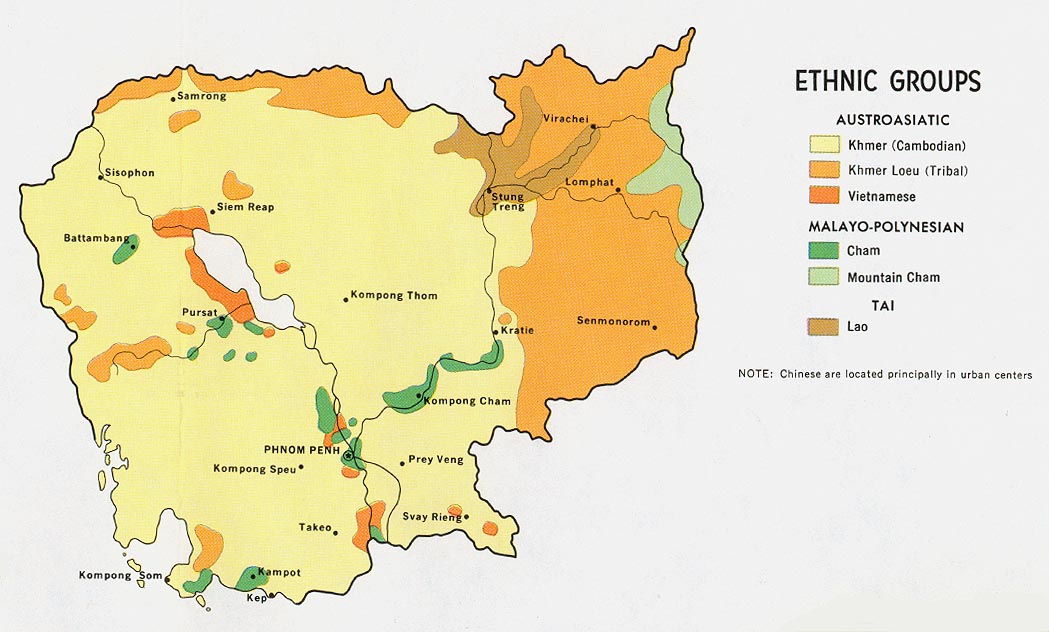
The Khmer are the majority and dominant people in the Southeast Asian nation of Cambodia. Khmer is the official language of Cambodia. Khmer civilization once ruled much of Southeast Asia. In the 1200s, the Thais and Vietnamese defeated the Khmer and pushed them into Cambodia, where most live today. The huge Angkor Wat temple complex in Cambodia gives evidence of past glories and is the major tourist site in the country.
Cambodia gained its independence from France in 1953. The communist Khmer Rouge ruled from 1975 to 1979 and murdered up to a quarter of the population. Today Cambodia is officially a constitutional monarchy, but it is a one-party authoritarian state.
The staple food for the Khmer is rice. Farmers also cultivate vegetables, tropical fruit, maize, and peanuts. Most villages raise some animals such as pigs, chickens and goats. A water buffalo is often a family’s most valuable possession.
Many young Khmer are leaving rural areas and moving to cities - especially Phnom Penh, the capital. Young people are looking for better jobs and educational opportunities. Since many young people lack job skills, they must take menial jobs in the cities. Unfortunately, some of them end up in the sex trade.
The Khmer marry within their ethnic group. Monogamy or marriage to one spouse is the norm. Couples often have large families, as many children in rural areas die before their 10th birthday. Malaria, malnutrition, lack of access to clean water and modern medicine lead to the death of many rural Cambodian people.
The Khmer people have been primarily Buddhist since the 13th century. Central Khmer are Buddhist with elements of Hinduism and animism. Relics of ethnic religions such as ancestor worship (praying to deceased ancestors) and spirit worship are very real. Most Buddhists also practice animism, a belief in the spirit world. In animism, evil spirits must be appeased through prayers, sacrifices and rituals.
Buddhism is based on the teachings of Siddhartha Gautama or the Buddha. He lived in the 6th and 5th century BC in ancient India. Few Khmer are familiar with the teachings of Siddhartha Gautama. Buddhism is a key part of their identity, however.
The Khmer usually celebrate Buddhist holidays. Two of the important Buddhist yearly holidays are Vesak, the Buddha's birthday celebrated in May or June and Bodhi Day, the holiday which commemorates the day that the historical Buddha experienced enlightenment under a Bodhi tree in December. Certain foods are required, and it is believed that eating these foods on an auspicious day will bring one good fortune throughout the year.
Many Christian resources exist in the Khmer language including a complete Bible and the JESUS Film. The Khmer need to see the love of Christ shown to them in practical ways. Outside of the cities the Khmer people often lack appropriate schools for their children, access to electricity, clean water and modern medicine.
Ask God to send workers to the Khmer to share the gospel and meet key needs such as education, clean water and medicine.
Pray for a movement among the Khmer that will result in the multiplication of churches through many generations.
Pray that Khmer believers would be established in the faith and share the good news with their family and friends, leading to entire households coming to faith.
Ask God to bring healing from the tragedies brought about by the Khmer Rouge.
Scripture Prayers for the Khmer in Cambodia.
| Profile Source: Joshua Project |
| People Name General | Khmer |
| People Name in Country | Khmer |
| Pronunciation |
kuh-MARE
|
| Alternate Names | Cambodians; Central Khmer; Cu Tho; Cur; Kampuchean; Khmer Krom; Khmer Nam Bo; Khmer, Northern; Kho Me; Khơ-me; Kmer; Ku; Mien; Thai-Khmer; West Cham |
| Population this Country | 14,235,000 |
| Population all Countries | 16,122,000 |
| Total Countries | 13 |
| Indigenous | Yes |
| Progress Scale | 1 ● |
| Unreached | Yes |
| Frontier People Group | No |
| GSEC | 1 (per PeopleGroups.org) |
| Pioneer Workers Needed | 285 |
| People ID | 12662 |
| ROP3 Code | 104946 |
| ROP25 Code | 303980 |
| ROP25 Name | Khmer |
| Country | Cambodia | ||
| Region | Asia, Southeast | ||
| Continent | Asia | ||
| 10/40 Window | Yes | ||
| National Bible Society | Website | ||
| Persecution Rank | Not ranked | ||
| Location in Country | Widespread Source: Ethnologue 2016 | ||
| Country | Cambodia |
| Region | Asia, Southeast |
| Continent | Asia |
| 10/40 Window | Yes |
| National Bible Society | Website |
| Persecution Rank | Not ranked |
| Location in Country | Widespread. Source: Ethnologue 2016 |
| Primary Religion: | Buddhism |
| Religion Subdivision: | Theravada |
| Major Religion ▲ | Percent |
|---|---|
| Buddhism |
89.90 %
|
| Christianity (Evangelical 1.30 %) |
3.10 %
|
| Ethnic Religions |
4.00 %
|
| Hinduism |
0.00 %
|
| Islam |
1.00 %
|
| Non-Religious |
2.00 %
|
| Other / Small |
0.00 %
|
| Unknown |
0.00 %
|
| Primary Language | Khmer (14,235,000 speakers) |
| Language Code | khm Ethnologue Listing |
| Language Written | Yes ScriptSource Listing |
| Total Languages | 1 |
| Primary Language | Khmer (14,235,000 speakers) |
| Language Code | khm Ethnologue Listing |
| Total Languages | 1 |
| People Groups | Speaking Khmer |
Primary Language: Khmer
| Bible Translation ▲ | Status (Years) |
|---|---|
| Bible-Portions | Yes (1899-1933) |
| Bible-New Testament | Yes (1929-1993) |
| Bible-Complete | Yes (1954-2016) |
| FCBH NT (www.bible.is) | Online |
| YouVersion NT (www.bible.com) | Online |
| Possible Print Bibles | |
|---|---|
| Amazon | |
| World Bibles | |
| Forum Bible Agencies | |
| National Bible Societies | |
| World Bible Finder | |
| Virtual Storehouse | |
| Photo Source | Copyrighted © 2024 Ari V - Shutterstock All rights reserved. Used with permission |
| Map Source | People Group location: IMB. Map geography: ESRI / GMI. Map design: Joshua Project. |
| Video Source | The Waiting World |
| Profile Source | Joshua Project |
| Data Sources | Data is compiled from various sources. Learn more. |