


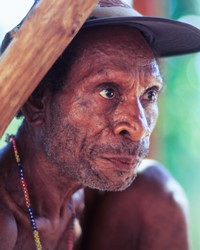

The Apaka Ama are a small indigenous people of Papua New Guinea, living in East Sepik Province in the Ambunti area south of the Sepik River. Their name appears in comma form, so the correct profile form is Apaka Ama. Their language is Sawiyanu, also known more broadly in outside linguistic sources as Ama. Public language references place their villages on hills rising from swamp country south of the Sepik River, including Ama, Kauvia, Waniap Creek, Wopolu II, and Yonuwai. That setting places them among the many small, locally rooted peoples of the Sepik region whose identity is tied to a distinct language, village life, and inherited land rather than to larger regional ethnic blocs.
Detailed public historical writing focused specifically on the Apaka Ama is limited, so it is better to be careful than to overstate what is not well documented. What can be said with confidence is that they belong to the dense mosaic of Sepik peoples where oral tradition, kinship, and local continuity carry more weight than written historical records.
The Apaka Ama are best understood as a rural village people living in swamp-edge and hill communities south of the Sepik River. That geography matters. Villages in this kind of terrain are often relatively isolated, with daily life shaped by footpaths, waterways, and close dependence on nearby land and water rather than on urban infrastructure. Since the available location data specifically places them on hills rising from swamp country, it is reasonable to picture a people whose settlements are small, local, and shaped by difficult access.
Their livelihood is most likely similar to many village communities in the Sepik region: small-scale gardening, subsistence food production, and local exchange when travel allows. Meals in such places often center on root crops, bananas, greens, and whatever can be grown or gathered nearby, though specific Apaka Ama food customs are not well documented in accessible sources. Family and community life in settings like this is usually communal rather than commercial, with extended kin networks carrying real weight in work, marriage, and daily responsibilities. Social life likely revolves around family gatherings, storytelling, singing, village events, and church life where Christianity has some influence. Their language remains a strong marker of identity, while Tok Pisin often serves as a wider language in Papua New Guinea beyond the immediate community. Because direct ethnographic reporting on this specific group is sparse, these daily-life details should be held with appropriate humility.
The Apaka Ama are mostly identified with ethnic religion, though there is also a meaningful Christian presence among them. That means they should not be treated as a people with no gospel witness, but neither should outward Christian identity be assumed to reflect deep biblical faith. Where ethnic religion remains dominant, people often continue to place trust in the spirit world, inherited rituals, or traditional spiritual practices rather than resting fully in Jesus Christ alone.
Because there is also a Christian witness among them, some may identify as Christian while still carrying older spiritual loyalties. If Christ is named while fear of spirits, ritual dependence, or trust in inherited religious systems remains central, then the gospel has not yet taken root in biblical clarity. Scripture resources are reported as available in their language, and the New Testament is listed as available.
The Apaka Ama need a clear and faithful gospel witness that calls them to turn from every competing spiritual loyalty and trust Christ alone. Since ethnic religion still appears to shape much of their worldview, they need more than occasional exposure to Christian ideas. They need genuine conversion, strong discipleship, and local believers who will stand firmly against syncretism.
They also likely face practical challenges common to small swamp-edge and village communities in East Sepik. Better access to medical care, stronger basic education, clean water, and dependable transportation can make a real difference when villages are separated by difficult terrain and limited infrastructure. In places where geography itself creates barriers, ordinary needs can become much heavier burdens. Practical help matters, but it should support the deeper need for enduring Christian maturity and a faithful local witness.
Pray that the Apaka Ama would turn from every spirit-centered religious practice and trust in Jesus Christ alone.
Pray that the Christian witness among them would be biblically clear, courageous, and free from compromise.
Pray for better access to medical care, education, clean water, and transportation in their communities.
Pray that believers among the Apaka Ama would grow into mature disciples and shine clearly to nearby peoples.
Scripture Prayers for the Ama, Apaka in Papua New Guinea.
https://www.ethnologue.com/language/amm/
https://en.wikipedia.org/wiki/Ama_language_(New_Guinea)
https://glottolog.org/resource/languoid/id/amap1240
| Profile Source: Joshua Project |



