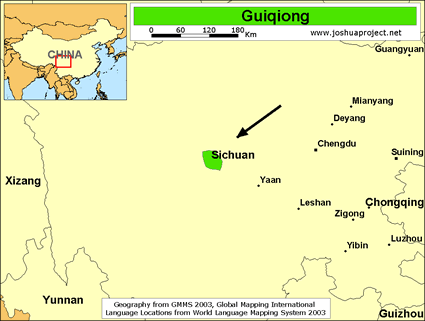

The historical border region between the Chinese and Tibetans has witnessed the fusion and assimilation of numerous tribes. The area inhabited by the Guiqiong was formerly part of the province of Xikang. In the 1930s Xikang was a lawless place that few outsiders dared to enter. "Aborigines [minorities] seize and kill members of other nationalities. In parts of Xikang, abandoned hovels and wasteland due to pillage are common sights. Violent attacks on communities by 'aborigines', as well as government punitive actions against them, cost many tens of thousands of lives."
The Guiqiong have been included as part of the Tibetan nationality in China. As early as 1930, however, Chinese researchers stated, "The language and customs of the Guiqiong are distinct from those of either the Chinese or Khampa Tibetans. The people here are actually a unique ethnic group."
One of the main reasons for the extreme violence throughout Xikang in the 1930s and 1940s was the drug trade. Large quantities of opium were manufactured throughout the region until the communist takeover in the early 1950s. The new government forced the people of western Sichuan to destroy their opium crops.
Today most Guiqiong grow maize and barley, while those living near the river, or some other source of water grow vegetables.
Recreation is closely tied to community life and cultural expression. Leisure activities are not usually separated from daily routines but are woven into the rhythms of village life and social gatherings.
The Guiqiong enjoy coming together for communal events, especially during seasonal celebrations or local festivals. At these times, people participate in traditional singing and dancing, which serve as both entertainment and a way of preserving their cultural identity. Group dances often involve coordinated movements and rhythmic music, allowing individuals to take part in a shared experience that strengthens community bonds.
Storytelling is another important form of recreation. Elders and community members pass down oral traditions, recounting historical events, moral lessons, and cultural narratives. These storytelling moments provide enjoyment while also reinforcing values and identity among younger generations.
Music also plays a meaningful role in leisure. Songs may be performed during gatherings or informal evenings, with participation from multiple members of the community. These musical expressions are often simple but deeply rooted in tradition, reflecting both personal and collective experiences.
In addition to organized activities, recreation often includes visiting with friends and relatives, sharing meals, and engaging in conversation. These everyday interactions are valued as opportunities for rest and relationship-building. Life among the Guiqiong places strong emphasis on community, and even simple forms of leisure are centered on connection and shared presence.
Overall, recreation for the Guiqiong people reflects a lifestyle where enjoyment, tradition, and social unity are closely linked, rather than separated into distinct or individual pursuits.
The Guiqiong are nominally Tibetan Buddhists, although they retain many aspects of animism and shamanism in their religious beliefs.
The Guiqiong have no understanding of the gospel or the name of Jesus Christ. They have been cut off from the message of eternal life for centuries. James O. Fraser described the tenacity needed to reach groups such as the Guiqiong: "Evangelistic work on the mission field is like a man going about in a dark, damp valley with a lighted match in his hand, seeking to ignite anything ignitable... here a shrub, there a tree, here a few sticks, there a heap of leaves take fire and give light and warmth, long after the kindling match and its bearer have passed on. And this is what God wants to see ... little patches of fire burning all over the world."
Without the guidance of Christ, these people will be lost in this life and the life to come. They need someone to go to them as Christ-bearers.
Pray for the Lord to intervene in their families, calling people to his side.
Pray for tenacious workers.
Pray for their hearts to be drawn to the Lord of lords.
Pray for a church planting movement to thrive in their communities.
Scripture Prayers for the Guiqiong in China.
Operation China, Asia Harvest, Copyrighted © Used with permission
| Profile Source: Joshua Project |