


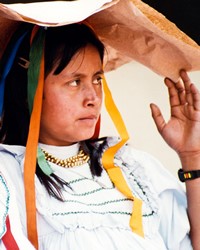

The San Martin Quechua inhabit the mountain valleys and cloud forest regions of San Martin department in northern Peru. They are part of the broader Quechuan language family whose roots trace to the Inca Empire, which spread this language throughout the Andes in the fifteenth century. The Quechua language became the lingua franca of the Spanish colonial administration after the sixteenth-century conquest, enabling communication between conquistadors and indigenous peoples. The San Martin region, with its mix of highland and cloud forest ecology, developed its own distinct Quechua dialect as communities adapted to mountain agriculture and valley settlement.
Spanish conquest profoundly transformed Quechua civilization. The colonial period brought forced labor systems, disease, and cultural disruption, yet the Quechua persisted in maintaining their language and identity despite centuries of oppression. Moyobamba, established as the first Spanish city in the Peruvian Amazon in 1540, served as a base for colonial administration and missionary activity. The San Martin Quechua retained their mountain communities and continued agricultural traditions while gradually incorporating Catholicism into their worldview. Modern San Martin development has brought increased access to education and economic opportunities, though many communities remain isolated in mountainous terrain.
The San Martin Quechua are primarily mountain farmers cultivating crops adapted to their highland environment. Potatoes, maize, beans, and root crops form the foundation of their diet and subsistence economy. Many families raise livestock including cattle, pigs, and chickens on small plots. Contemporary San Martin communities engage in agricultural production, animal husbandry, and increasingly, craft production and small commerce to generate income.
Family organization centers on extended kinship networks and communal agricultural work called "ay-nee," where communities organize workdays for planting and harvesting. Marriage traditionally involved parental consent and community approval, though modern practices are changing. Households typically include multiple generations working together in agricultural tasks and daily subsistence. Women play vital roles in food preparation, weaving, and household management. Men contribute to field agriculture and animal care while engaging in woodcarving and craft production.
Food reflects mountain agriculture with meals emphasizing potatoes prepared in diverse traditional ways, supplemented with beans, corn dishes, fresh vegetables from mountain gardens, and occasionally meat from domestic animals. Communal meals reinforce family and social bonds. Traditional celebrations center on agricultural cycles and Catholic feast days. Harvest festivals and Inti Raymi (the Inca sun festival) celebrations involve community gatherings, shared meals, music, and dancing. The Matachines tradition, a ceremonial masked dance, connects contemporary San Martin communities to ancestral warrior heritage.
The San Martin Quechua speak their native Highland Quechua dialect while increasingly adopting Spanish for communication beyond their communities, particularly among younger generations. Traditional music featuring indigenous flutes and huayno songs preserves ancestral narratives and cultural identity.
Traditional Quechua spirituality centered on reverence for Pachamama (Mother Earth), the sun god Inti, and other natural forces. Shamans conducted healing rituals and ceremonies maintaining spiritual balance. This animistic worldview guided all aspects of life from agricultural timing to healing and community decisions.
Spanish colonization imposed Catholicism through missionary efforts and forced conversion. The San Martin Quechua incorporated Catholicism into their existing worldview, creating folk Catholicism—a syncretic blend where Catholic saints coexist with traditional Andean spiritual concepts. Pacha Mama became associated with the Virgin Mary, and many rituals incorporate both Catholic and indigenous elements. This syncretism reflects both adaptation and cultural resistance.
In recent decades, evangelical Protestant churches have expanded throughout Peru's indigenous communities, including among the San Martin Quechua. Growing numbers of believers have embraced evangelical Christianity with genuine spiritual commitment. However, the majority of San Martin Quechua remain nominally Catholic, combining Catholic ritual with underlying indigenous beliefs. Many lack understanding of biblical truth and the transformative gospel message.
Language erosion threatens Quechua transmission as Spanish increasingly dominates education and commerce, particularly among youth. Educational infrastructure requires strengthening with culturally-appropriate curriculum honoring indigenous knowledge alongside academic learning. Economic pressures force migration to urban areas and abroad for employment, separating families and eroding cultural continuity.
Healthcare access remains limited in remote mountain communities, with residents often traveling long distances for medical treatment. Poverty persists despite modern economic development, with many San Martin families struggling for adequate subsistence. Discrimination from mestizo society creates barriers to economic opportunity and social dignity.
Spiritually, San Martin Quechua require clear gospel witness presenting Jesus Christ as Savior and Lord. Churches need indigenous pastors and evangelists equipped with theological training and cultural sensitivity to establish local congregations independent of foreign missionaries. Disciple-making resources addressing Quechua worldview remain critically needed.
Pray that the San Martin Quechua encounter Jesus Christ through clear gospel witness, experiencing genuine conversion that transforms hearts and establishes personal faith in Christ.
Ask God to raise up from within San Martin communities Spirit-gifted evangelists, pastors, and teachers who understand their culture and language intimately, proclaiming Christ's love with authenticity and power.
Intercede for Bible translation in the Highland Quechua dialect and development of discipleship resources addressing their worldview, enabling spiritual transformation through God's word.
Pray that San Martin Quechua believers become bold witnesses among neighboring less-reached communities throughout the Peruvian highlands.
Scripture Prayers for the Quechua, San Martin in Peru.
Britannica. "Peru — Quechua, Aymara, Spanish." https://www.britannica.com/place/Peru/Languages
Ethnologue. "Quechua, San Martin Language (QUS)." https://www.ethnologue.com/language/qus/
Prayercast. "Peru Prayer Focus." https://prayercast.com/prayer-topic/peru/
Quechua Missions. "Quechua People." https://quechuamissions.com/quechua-people
Study.com. "Quechua Tribe: Location, Language, History & Culture." https://study.com/academy/lesson/quechua-tribe-location-language.html
Wikipedia. "Religion in Peru." https://en.wikipedia.org/wiki/Religion_in_Peru
| Profile Source: Joshua Project |



