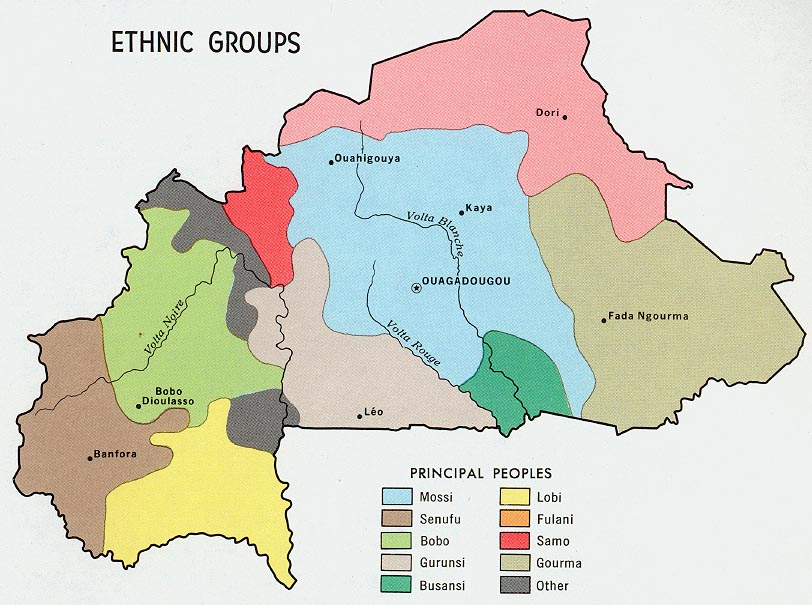

Khe in Burkina Faso are a small ethnolinguistic people of southwestern Burkina Faso. The strongest confirmed outside evidence identifies Khe (also called Kheso) as a distinct language of Burkina Faso within the Gur branch of the Niger-Congo family, and outside sources specifically note that it is closely related to Dogoso. That matters because it shows the Khe are not simply a local nickname inside a larger people, but a real language community with a recognized place among the smaller peoples of southwestern Burkina Faso.
Their history is best understood through small-community continuity rather than through large written political history. Public ethnographic material focused narrowly on the Khe is scarce, so it would be careless to overstate exact migration stories or political structures. What can be said with confidence is that they are one of the many smaller Gur-speaking peoples of Burkina Faso whose identity has likely been preserved through village life, kinship ties, and continued use of their language despite pressure from stronger regional languages. A major study of African language endangerment specifically lists Khe (Kheso) among the highly endangered languages of Burkina Faso, which strongly suggests a small people living under real linguistic and cultural pressure.
Their language is Khe, also called Kheso and in some sources Bambadion-Kheso. Outside sources identify it as a Gur language and describe it as endangered, with evidence suggesting it may be used mainly by adults and not regularly taught in school. Another outside source notes that Khe is spoken in Burkina Faso, is close to Dogoso, and that speakers may also be literate in French. This suggests a small language community where their language likely remains most important in home and local community life, while French, Jula (Dyula), or other wider languages may be used in broader trade, schooling, or administration.
Khe in Burkina Faso likely live in small rural communities in the southwest, in the part of the country where many small Gur-speaking and related language groups live alongside one another. Because public sources focused specifically on Khe daily life are limited, caution is necessary. Still, the broader regional context is clear enough to say they likely live in village settings shaped by subsistence farming, family labor, local markets, and multilingual interaction with surrounding peoples. Burkina Faso is highly multilingual, and southwestern Burkina Faso in particular is known for clusters of smaller languages living under the growing influence of larger trade languages.
Because exact Khe-specific descriptions of housing, food patterns, and village structure are not readily available in reliable public sources, it would be wrong to invent them. The safest and most accurate picture is that Khe in Burkina Faso are a small southwestern rural people whose lives are shaped by village belonging, agriculture, kinship, and the pressures that come when a small language community lives beside stronger regional languages and cultures.
Khe in Burkina Faso are identified primarily with ethnic religion, though there is also a visible Christian presence. The internal source clearly points to ethnic religion as their largest religious identity, and outside people-group data also presents them as a small community where traditional spiritual patterns remain strong even though some Christian witness exists. That means they should not be treated as a people with no Christian contact, but neither should they be treated as a deeply discipled Christian people.
Where ethnic religion remains central, people often live under inherited spiritual fears, ritual obligations, sacred customs, and local understandings of blessing, sickness, protection, and misfortune. These beliefs are not merely abstract ideas but can be woven into family and village life. Some among the Khe may have had real exposure to Christian teaching. Others may still be shaped mainly by inherited spiritual frameworks or by mixed beliefs. Their deepest need is true repentance and faith in Jesus Christ, freedom from fear-based spiritual bondage, and lives brought under the authority of God's Word. Scripture availability is confirmed internally, but this profile will not turn that into a stated need or prayer for translation, per your standing rule.
Khe in Burkina Faso need clear and faithful gospel witness in a setting where they are both small and culturally vulnerable. Small peoples like this are often overlooked because they are assumed to be absorbed into broader regional populations. But that is exactly why intentional ministry matters. They need to be seen as a distinct people, not simply treated as part of the wider southwestern Burkina Faso environment.
They also need discipleship that takes seriously the reality of language pressure and cultural pressure. Multiple outside sources indicate that Khe is endangered, and one source suggests it may now be used mainly by adults and not passed on strongly in formal settings. That does not mean the people have disappeared, but it does mean ministry must be relational, patient, and clear in the language people actually understand best. The issue is not preserving identity for its own sake, but ensuring the gospel is deeply understood and not reduced to shallow familiarity in a multilingual environment.
Because they are a small rural people, they may also be vulnerable to syncretism, inherited fear, and community pressure. If someone turns openly to Christ, family and social expectations may weigh heavily, especially where traditional beliefs remain active. New believers need wise pastoral care, strong local fellowship, and steady biblical teaching. Their rural setting may also bring practical challenges such as transportation, education, medical access, and regular connection to mature biblical teaching. These should be prayed for carefully and without exaggeration, because practical isolation can directly affect whether believers receive ongoing discipleship and whether healthy local fellowship becomes durable.
Pray that Khe in Burkina Faso would hear a clear and faithful witness to Jesus Christ and come to know him as Savior and Lord.
Pray that fear of spirits, inherited ritual obligations, and every form of spiritual bondage would be broken by the power of Christ.
Pray that those who already have some Christian exposure would move beyond surface familiarity into deep repentance, true faith, and joyful obedience to Jesus Christ.
Pray for open doors into Khe homes and relationships, so the gospel would be received with humility and seriousness in a small, easily overlooked community.
Pray for faithful believers and church leaders who can patiently disciple Khe in Burkina Faso and help establish strong local fellowships rooted in Scripture.
Pray for practical help where needed in areas such as transportation, medical access, education, and regular connection to strong biblical teaching in rural communities.
Scripture Prayers for the Khe in Burkina Faso.
https://www.ethnologue.com/language/kqg/
https://en.wikipedia.org/wiki/Khe_language
https://globalrecordings.net/en/language/kqg
https://en.wikipedia.org/wiki/Languages_of_Burkina_Faso
https://langsci-press.org/catalog/view/120/1317/1095-3
| Profile Source: Joshua Project |