


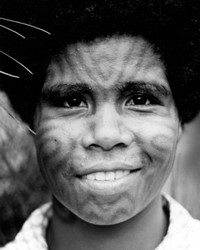

The Korape are an indigenous Papuan people living on the dramatic Cape Nelson headlands of the Tufi District in Oro Province, Papua New Guinea. Their homeland is one of the most geographically striking settings in all of the Pacific — a coastline of deep volcanic fjords where steep, forested cliffs plunge vertically into the warm waters of the Solomon Sea. These submerged river valleys, formed by ancient volcanic activity, give the Cape Nelson coast a landscape unlike almost anywhere else in Melanesia and have shaped Korape life, travel, and identity for generations.
The Korape speak Korafe-Yegha, a language belonging to the Binanderean branch of the Trans-New Guinea language family. The language has been notably influenced by neighboring Oceanic languages, reflecting centuries of contact with coastal trading partners. The Korafe are also known by alternate names including Kwarafe and Kailikaili, the latter a name used by neighboring language groups. First formal Western contact came in 1890, when British administrator William MacGregor made initial contact with the Korape during an expedition along the north coast. A government station was established at Tufi in 1900, and in 1934 an Anglican Mission station was opened at Sefoa, which the Korape welcomed for the education and healthcare it provided. That Anglican presence has remained the dominant religious influence in the region ever since. Oro Province is today the only province in Papua New Guinea where the Anglican Church is the majority denomination. The Korape's involvement in World War II, when the Tufi area served as a significant military outpost, further expanded their engagement with the wider world and heightened the value they placed on education.
The Korape live in villages along the fjord coastline and in adjacent inland valleys, where subsistence gardening and fishing sustain daily life. Taro, sweet potatoes, bananas, and other garden crops are the staples of the household diet, while fishing in the sheltered fjords and surrounding ocean provides an important source of protein. Sago processing supplements the food supply, as it does for many communities across the region. The deep fjords that define the landscape serve as the primary corridors of travel and trade, with canoes remaining essential to movement between communities.
Church feast days are a central feature of community celebration, having over time become the primary occasion for the kind of communal gathering and reciprocal feasting that once characterized the traditional vasai trading partner system. Anglican parishes serve as the social anchor for these celebrations, drawing together villages in shared worship, food, and fellowship. Education is highly valued among the Korape, a priority that took root in the mission school era and deepened through post-war engagement with the broader national life of Papua New Guinea. The wantok system — the network of obligation and mutual support linking people through shared language and kinship — continues to shape how families and clans relate to one another. English is spoken more widely here than in many remote communities, reflecting both the region's educational history and its contact with visitors to the Tufi area.
Christianity is the primary religion of the Korape, and the community is classified as significantly reached with a strong evangelical presence. The Anglican Church has been the dominant Christian tradition since the establishment of the Sefoa mission station in 1934, and Protestant Christianity has shaped the fabric of Korape community life across several generations. The New Testament in Korafe-Yegha was completed in 1984 and reprinted in 2014, and Bible portions were published in 2009. The New Testament is accessible in both print and digital formats through multiple platforms, giving the Korape meaningful access to God's Word in their heart language. No complete Bible in Korafe-Yegha has yet been reported.
A portion of the community continues to hold traditional ethnic religious beliefs. The Korape historically maintained a worldview in which spiritual forces, magic, and the spirit world played a large role in community wellbeing.
They need the completion of a full Bible in the Korafe-Yegha language. The New Testament is a precious resource that the church has carried for four decades, but the full word of God — the Psalms, the wisdom books, the law, and the prophets — remains unavailable to Korafe readers in their own tongue. Completing that translation would give the Korape church the complete scriptural foundation it needs to teach, disciple, and train the next generation of local leaders.
Those leaders need ongoing biblical training and access to discipleship resources so they can shepherd their congregations with depth and consistency, calling their communities to genuine and maturing faith in Jesus Christ rather than nominal religious belonging. Physically, the fjord coastline geography that makes the Cape Nelson area so spectacular also creates real challenges. Healthcare access in remote coastal communities is limited, and reaching a hospital in a medical emergency requires travel by sea or air. Quality education beyond the primary level requires young people to travel away from their home communities, creating pressures for families navigating the pull between village life and wider opportunity.
Pray for the completion of a full Bible in the Korafe-Yegha language, so that the Korape would one day have the entire Word of God available to read, teach from, and treasure in their own tongue.
Pray for faithful, well-trained Korape church leaders who will preach the gospel with clarity and depth, shepherd their communities toward genuine faith in Christ, and address any remaining traditional beliefs with biblical truth and pastoral courage.
Pray for improved access to healthcare and educational opportunity for Korape families in the remote fjord communities of Cape Nelson, and that the local church would be a source of practical hope and compassion.
Pray that the Korape, already significantly reached with the gospel and possessing the New Testament in their language, would be stirred to become a sending community — raising up believers who carry the name of Jesus to less-reached peoples throughout Asia.
Scripture Prayers for the Korape in Papua New Guinea.
| Profile Source: Joshua Project |



