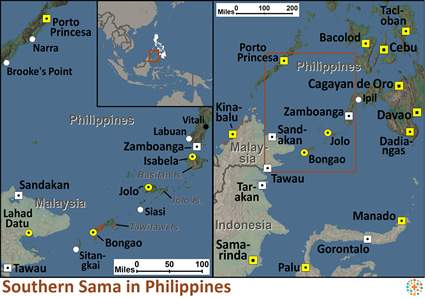

The Southern Sama are one of the many peoples belonging to the larger Sama-Bajau ethnolinguistic family of the southern Philippines. They are found primarily in the Sulu Archipelago, particularly in the provinces of Tawi-Tawi, Sulu, and nearby coastal regions of Mindanao. The Southern Sama are closely related to other Sama groups but maintain their own language varieties, traditions, and community identities. Their language belongs to the Sama-Bajaw branch of the Austronesian language family and serves as an important marker of cultural identity.
Historically, the Southern Sama lived in coastal settlements and island communities connected by trade routes throughout the Sulu Sea. Some groups were traditionally involved in fishing and maritime commerce, while others engaged in farming and trade on larger islands. For centuries they interacted with neighboring Tausug, Yakan, and other Moro peoples and became integrated into the broader Islamic culture of the southern Philippines. Their history has been shaped by maritime trade, regional sultanates, and the strong influence of Islam throughout the Sulu Archipelago.
The Southern Sama traditionally live in coastal villages, often in homes built near the shoreline or over shallow waters. Fishing remains one of the most important occupations, with many families relying on the sea for food and income. Others engage in farming, coconut cultivation, small-scale trade, transportation, and various forms of wage labor. In some areas, families participate in seaweed farming and other marine industries that support local economies.
Family relationships are highly valued, and extended families provide social, economic, and emotional support. Village life is often characterized by close-knit communities where cooperation and mutual assistance are important. Respect for elders, hospitality, and loyalty to family remain significant cultural values. Traditional foods commonly include fish, rice, coconuts, cassava, and other locally available products.
Community gatherings, weddings, religious celebrations, and cultural festivals help strengthen social ties and preserve traditions. Although modernization has brought new educational and employment opportunities, many Southern Sama continue to maintain strong connections to their maritime heritage and ancestral communities.
The Southern Sama are predominantly Sunni Muslims. Islam plays a central role in community life, influencing family relationships, moral values, religious observances, and social customs. Daily prayers, Ramadan fasting, mosque attendance, and celebration of Islamic festivals are important aspects of their religious practice.
Alongside Islamic beliefs, some Southern Sama communities retain elements of older animistic traditions. Beliefs concerning spirits, supernatural beings, sacred places, and traditional healing practices continue to influence the worldview of some families. In certain areas, these older beliefs exist alongside Islamic observance, creating forms of religious syncretism that have been passed down through generations.
Most Southern Sama know Jesus primarily as a prophet within Islamic teaching and have had little opportunity to hear the biblical message that He is the Son of God who died and rose again to provide salvation. Access to evangelical Christian witness and discipleship remains limited in many Southern Sama communities.
The Southern Sama need greater access to the gospel through trusted relationships, Scripture resources in languages they understand, and faithful believers who can communicate biblical truth with wisdom and cultural sensitivity. Because of their strong Islamic identity and close-knit communities, meaningful gospel engagement often requires long-term relationships built on trust and genuine care.
Many Southern Sama communities also face practical challenges related to poverty, education, healthcare access, employment opportunities, and infrastructure development. Coastal communities may be especially vulnerable to environmental changes, storms, and fluctuations in fishing income. Efforts that strengthen families, improve educational opportunities, and support sustainable livelihoods can help address practical needs while creating opportunities for meaningful relationships.
Above all, the Southern Sama need opportunities to encounter Jesus Christ through God's word, understand the gospel clearly, and see transformed lives through the witness of mature believers and healthy fellowships of faith.
Pray that the Southern Sama would have many opportunities to hear a clear presentation of the gospel and understand the saving work of Jesus Christ.
Pray that God would raise up faithful workers who will build genuine relationships among the Southern Sama and communicate biblical truth with wisdom, humility, and love.
Pray that the Southern Sama would be adopted through the People Group Adoption program so that churches and believers will commit to ongoing prayer, outreach, and future gospel engagement among them.
Pray that any existing believers among the Sama-Bajau peoples would be willing and able to disciple those who don't know Christ's truth.
Scripture Prayers for the Sama, Southern in Philippines.
https://en.wikipedia.org/wiki/Sama-Bajau
https://en.wikipedia.org/wiki/Ethnic_groups_in_the_Philippines
https://en.wikipedia.org/wiki/Banguingui_people
https://en.wikipedia.org/wiki/South_Ubian
https://www.peoplegroups.org/explore/GroupDetails.aspx
| Profile Source: Joshua Project |