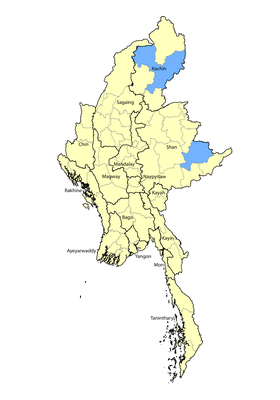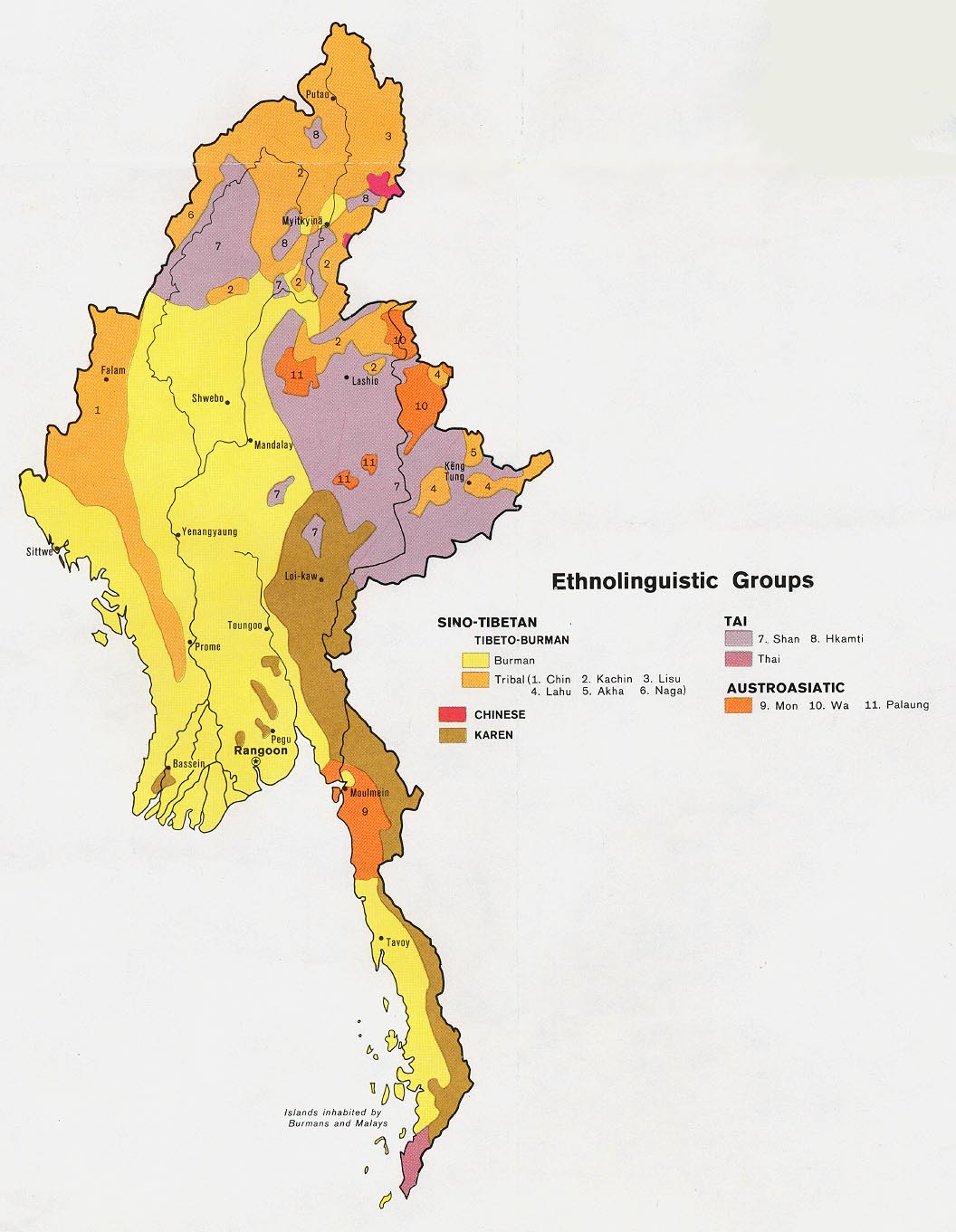

The Zaiwa live in northern Myanmar in the Waimaw area of Kachin State and in parts of Shan State, and their main language is Zaiwa, a Jingpo related language with a distinct linguistic classification. Most Zaiwa communities live across the border in Yunnan Province in China, where they form part of the wider Jingpo nationality. The Zaiwa maintain clan identities and local leadership traditions that have shaped social organization across generations.
Zaiwa was unwritten until modern missionary and linguistic efforts introduced a script and produced early Scripture translations. A Roman based orthography later became widely used for literacy and religious publications. Contemporary linguistic research documents Zaiwa phonology and syllable structure and notes ongoing concerns about language maintenance as younger generations increasingly use languages of wider communication in education and media.
Zaiwa communities live in village clusters where agriculture, local crafts, and seasonal livelihoods shape daily life. Cultural expression includes distinctive festivals and musical traditions, and community dances and wind instruments are part of public celebrations. Social life is organized around kin networks and customary institutions, and cross border ties with communities in Yunnan influence trade, family connections, and cultural exchange. The borderland context and regional security dynamics have affected movement and access to services for some communities.
In Myanmar, religious life among the Zaiwa reflects a mix of traditional spiritual practices and engagement with Christianity. Missionary activity and local Christian movements have reached many areas, and Scripture and audio resources have been produced in Zaiwa. At the same time, traditional ritual specialists and customary practices continue to play a role in many villages. Responses to the gospel have varied across localities, and conversion has sometimes been accompanied by social tensions in mixed communities. Wa people have responded better to the gospel than their cousins in China.
Zaiwa communities need culturally appropriate language support that strengthens literacy in the Zaiwa orthography and preserves oral traditions. Access to health services, education, and sustainable livelihood options that build on local ecological knowledge are priorities. Given the borderland setting and recent episodes of conflict and displacement reported in the region, communities also need reliable humanitarian access, safe movement for families, and locally led development planning that respects customary institutions.
Pray for believers from among the Zaiwa to grow as faithful workers, for the Holy Spirit to guide them and their families, and for them to be accurate and loving witnesses of Christ, especially to those in China.
Pray for improved access to healthcare and for practical support for families facing medical and wellbeing challenges.
Pray for expanded educational and vocational opportunities for children and youth, and for local and regional leaders to make wise and just decisions that benefit the community.
Pray for preservation of the Zaiwa language and oral traditions, and for sustainable stewardship of the local environment and natural resources.
Scripture Prayers for the Zaiwa in Myanmar (Burma).
Asia Harvest
U Min Naing, National Ethnic Groups of Myanmar, Thein Myint Win Press, two thousand
Richard K. Diran, The Vanishing Tribes of Burma, Amphoto Art, nineteen ninety-seven
Mark Wannemacher, "The Interaction of Tone, Phonation Type and Glottal Features in Zaiwa," Focus on Phonology: PYU Working Papers in Linguistics, Payap University, nineteen ninety-six
Mark Wannemacher, "Zaiwa Syllable Structure," Focus on Phonology, nineteen ninety-six
Tien Ju K'ang, Peaks of Faith: Protestant Mission in Revolutionary China, E. J. Brill, nineteen ninety-three
Jingpozu Shehui Lishi Diaozha [Historical and Ethnic Studies of the Jingpo Nationality], Yunnan Renmin, nineteen eighty-two
William James Sherlock Carrapiett, The Kachin Tribes of Burma, Government Printing and Stationery, nineteen twenty-nine
Reporting on displacement and conflict in Waimaw Township — contemporary news reporting and humanitarian situation summaries
Ola Hanson, The Kachins: Their Customs and Traditions, American Baptist Mission Press, nineteen thirteen
Paul Hattaway, Operation China: Introducing all the Peoples of China, Piquant, two thousand
Additional field notes and linguistic surveys on Zaiwa phonology and orthography
1 Estimated by a leader of the Kachin Baptist Convention who travels extensively among the Zaiwa communities. SIL gave a lower number of 33,000 Zaiwa in 2021, but that figure likely only refers to first language speakers of the Zaiwa language. 2 U Min Naing, National Ethnic Groups of Myanmar (Yangon: Thein Myint Win Press, 2000), p. 39. 3 Richard K. Diran, The Vanishing Tribes of Burma (New York: Amphoto Art, 1997), p. 80, says: "The connection between the Zaiwa and Jingpo goes back to the Kachin custom of tracing their descent through duwas or hereditary chiefs. Whenever a Zaiwa chief's family became extinct, they would elect a new chief and claim to be of Lahpai or Jingpo descent." 4 Many linguistic studies of Zaiwa have been conducted, with Mark Wannemacher writing two papers in the 1990s: "The Interaction of Tone, Phonation Type and Glottal Features in Zaiwa," Focus on Phonology: PYU Working Papers in Linguistics (no. 1, Chiang Mai: Payap University, 1996): pp. 1-16; and "Zaiwa Syllable Structure," Focus on Phonology (1996): pp. 119-125. 5 Tien Ju-K'ang, Peaks of Faith: Protestant Mission in Revolutionary China (Leiden, Netherlands: E. J. Brill, 1993), p. 145. 6 Jingpozu Shehui Lishi Diaozha [Historical and Ethnic Studies of the Jingpo Nationality] (Kunming: Yunnan Renmin, 1982), p. 161. 7 William James Sherlock Carrapiett, The Kachin Tribes of Burma (Rangoon: Government Printing and Stationery, 1929). 8 See https://en.wikipedia.org/wiki/Waingmaw_Township 9 T'ien, Peaks of Faith, p. 51, noted: "Zaiwa young men do not sleep at home. They usually spend the night flirting with young women at the youth club. Sexual relations are so disorderly as to render them unfit for physical labor. A girl who gets pregnant without a proposal will not easily find another boy to marry her and will be considered a widow because of the heavy bride-price. In Banwa Village alone, there were 55 such 'widows' from a total of 134 households." 10 Wei Kun, "The Jingpo Christians," Bridge (no. 43, September-October 1990), p. 16. Missionary Ola Hanson, The Kachins: Their Customs and Traditions (Rangoon: American Baptist Mission Press, 1913), p. 21, describes the Zaiwa as a "group that arose by intermarriage between the Maru and the Lahpai clans of Jingpo." 11 U Min Naing, National Ethnic Groups of Myanmar, p. 39. 12 One tragic example of the Zaiwa's bondage is retold in T'ien, Peaks of Faith, pp. 16-17: "Elder Dai's daughter-in-law died of fever after having a difficult labor. Before her death, several head of cattle were sacrificed to the demons. During the cremation, the firewood did not burn steadily due to its dampness. The sorcerer thereby proclaimed that the deceased's personal effects be thrown into the fire to annul her parsimony. As the fire still did not burst into a blaze, the sorcerer then attributed the cause to the deceased's reluctance to leave her newborn baby behind, thus resulting in the baby being thrown into the fire." 13 Paul Hattaway, Operation China: Introducing all the Peoples of China (Carlisle, UK: Piquant, 2000), p. 568. Zaiwa Christians were frequently "expelled from the villagers who would confiscate their land and livestock, compelling them to abandon their alien belief." (T'ien, Peaks of Faith, p. 144).
| Profile Source: Joshua Project |
| Other PDF Profile |