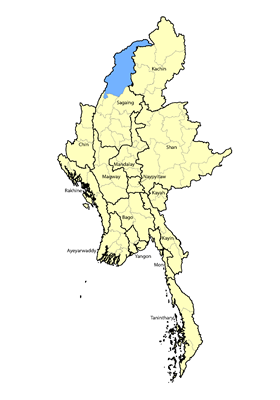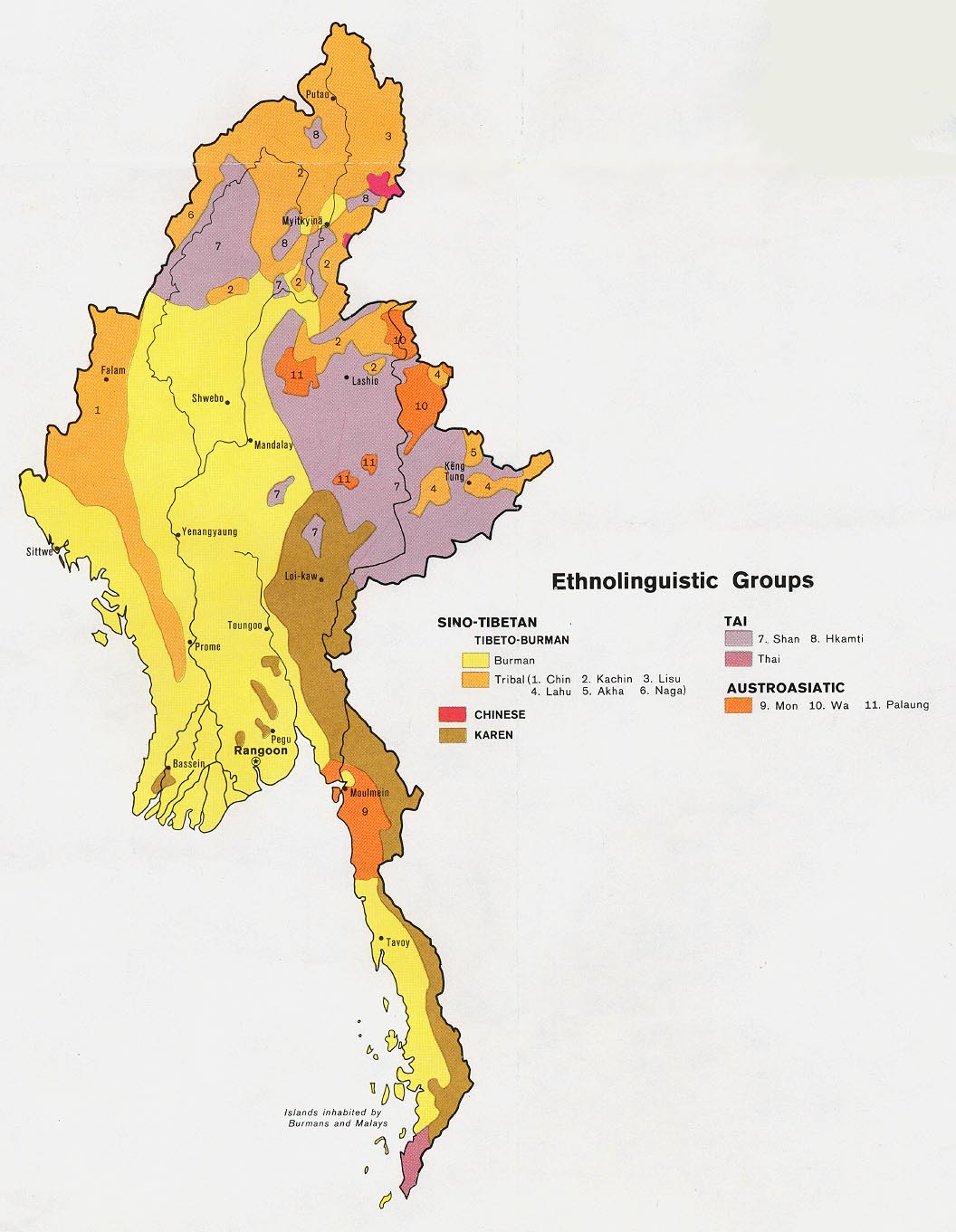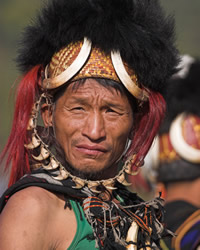

Mungre people live in Lahe and Nanyun townships in western Myanmar's Sagaing Region, near the Indian border. They are scattered among many villages, with most dwelling in Nanyun (30 households) and Namlip village (20), while 16 families identifying as "Choqhyul" people live in Takon village in Lahe Township. The Choqhyul appear to be a clan or subgroup of the Mungre. An additional 500 Mungre people live on the other side of the Pangsau Pass in Arunachal Pradesh, India, where they are officially known as the Morang tribe. Most Mungre in India are recent arrivals, with the 1981 Indian census listing their population as just 92 at the time.
The name of this tribe is derived from two words. Mung means "group of people" and re means "ladder." Thus, "they believe their ancestors lived with God, but they were sent down to the earth. They built a ladder to go back to the sky and to God but failed to do so. They then wanted God to come down to the earth." The Mungre are one of dozens of Tangshang-related groups in Myanmar that are collectively labeled "Tangsa" in India. Furthermore, in that country the tribes that arrived earlier are known as Tangwa, while the newer immigrants and those on the Myanmar side of the border are collectively given the label Pangsa.
In 2013, a team of linguists visited the Mungre people in Myanmar and surveyed 675 people. They found the Mungre are much more highly educated than other tribes in the area, having benefitted from having a high school in their area for many years. Although the Mungre language shares a very high 97 percent lexical similarity with Shecyu, which some consider the premier dialect for Scripture translation among Tangshang groups, a Mungre pastor said that "he does not use the Shecyu New Testament because his church members do not understand it." Attempts by the Baptist churches and others to shoehorn various tribes and language groups into using the few Tangshang Bible translations in existence have proven misguided and ignore the reality of the complex linguistic situation among tribes like the Mungre.
While almost all other people groups in the region traditionally had headmen who were part of a line of succession from father to son, the Mungre "followed a democratic system and elected their leaders from the best candidates available." Despite their modest size, the Mungre are divided into many clans, with 18 clans identified among them in India alone.
Mungre men dress like most other Tangshang tribes in India, while the women like to wear ornaments of silver, ivory, and semi-precious stones. In the past a bride price had to be paid to a Mungre bride's father as a form of repayment for the cost of raising her. The bride price typically consisted of "one buffalo, five pigs, rice beer, opium, bronze discs, and a dao (machete)." The Mungre love to perform traditional songs and dances, which gives them a sense of ethnic and cultural cohesion.
For centuries Mungre communities were served by two religious workers: changwai (priests) and tawhai (astrologers or diviners), whose job was to mediate between people and the spirit world. The Sarin-hok festival is celebrated in January, at which buffaloes, pigs and chickens were formerly sacrificed in a bid to procure the blessings of the deity of crops. Since most Mungre people have become Christians, the festivals have focused more on giving thanks to the living God for His abundant provision, and the former religious officials have been replaced by church leaders.
The Mungre people first heard the gospel in the 1960s, and by 1964 most of them had adopted Christianity. By God's grace, their ancient belief that God wanted to come down to them has been fulfilled in Jesus Christ. Approximately nine out of ten Mungre people in Myanmar are Christians today, while the 2011 Indian census found that 81 percent of "Morang" people there were Christians, along with a small number of Buddhists and animists.
Pray for the Lord to bless the Mungre people spiritually and physically.
Pray for spiritual renewal among Christian believers and freedom from syncretism.
Pray for the Lord to bless the work of their hands as they obey biblical principles.
Pray for the believers among them, that they will grow strong in faith and become part of the mission force, carrying the gospel to their own people and beyond.
Scripture Prayers for the Mungre in Myanmar (Burma).
Asia Harvest, Copyrighted 2026 © Used with permission
| Profile Source: Joshua Project |
| Other PDF Profile |