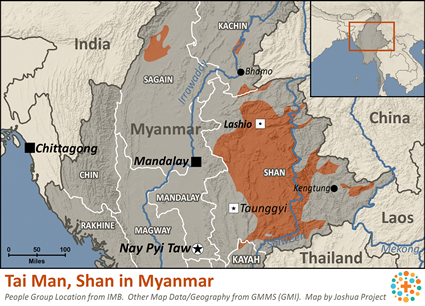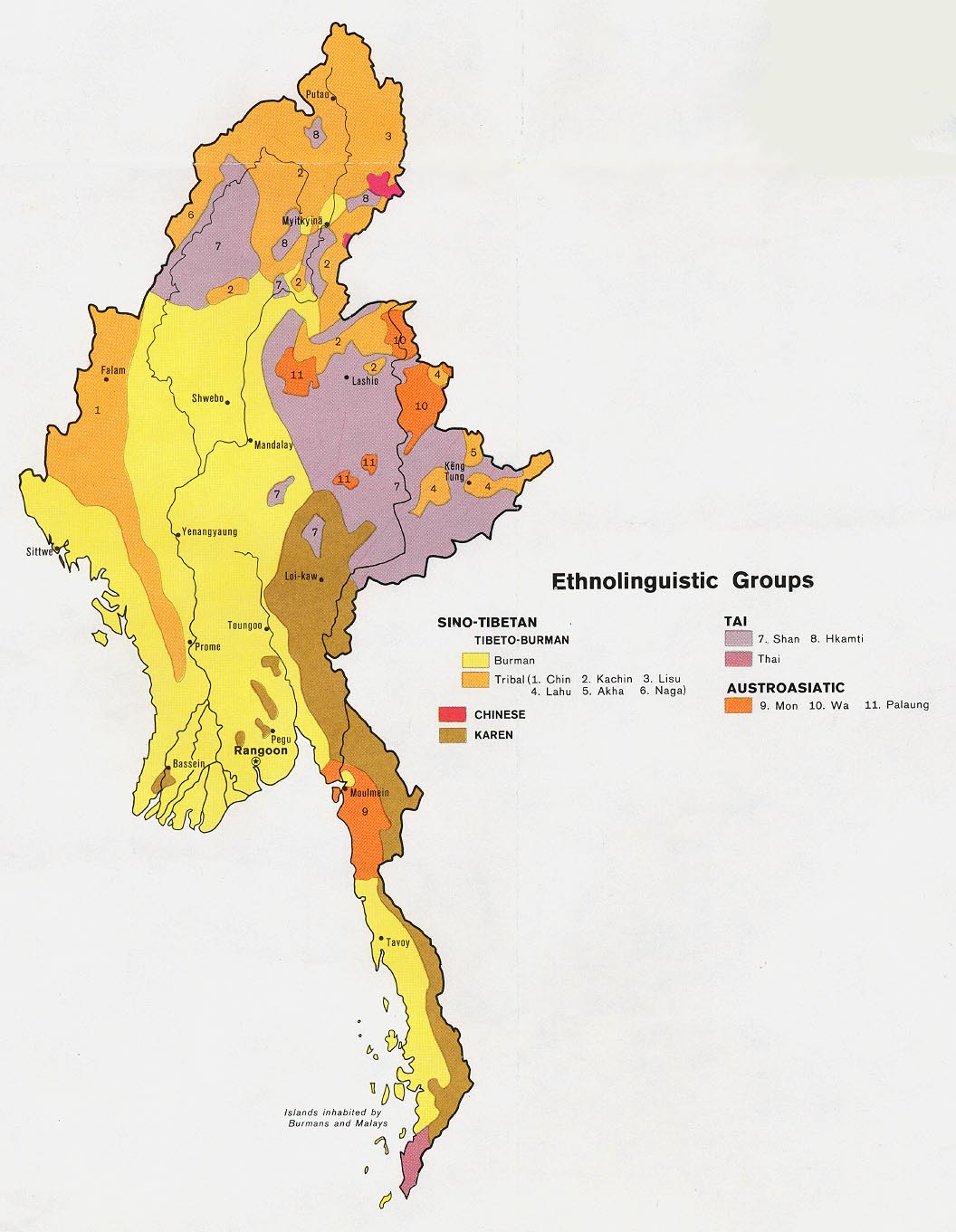

The Shan are one of the great ethnic groups of Southeast Asia. They dominate the large state in northern Myanmar that bears their name, and they are the second most populous ethnic group in the country after the Burmese. Numbering about five million people in Myanmar, more than 100,000 Shan also live in northern Thailand, with smaller communities in northeast India, Laos, and China. Shan refugees have also settled along the U.S. Pacific coast and in Colorado and Kansas.
The name "Shan" is a Burmese term that is cognate with "Siam," the former name of Thailand. They call themselves Lik Tai, or Tai Yai, which means "Great Tai." The Burmese further distinguish between subgroups they call Shan Gale ("little Shan") and Shan Gyi ("big Shan.") The Shan are descended from a large migration of Tai people from China that started in the 10th century. Many groups in China today are ethnically related to the Shan, but just one village remains in Yunnan Province whose inhabitants speak the same language as the Shan of Myanmar.
Shan, which has five tones, is part of the large Kra-Dai linguistic family. For centuries Shan has had its own alphabet, related to ancient Sanskrit, although Southern Shan was traditionally written in a script similar to Burmese. Pioneer missionary Josiah Cushing produced three early linguistic studies of Shan. Today, Shan has become the lingua franca of many people groups in Shan State, and at least a dozen tribes speak Shan as a second language.
Although accounts of Tai peoples in China date back 4,000 years, following the Mongol invasion of northern Burma in 1287, "the Shan established a power base with their capital at Ava outside modern Mandalay. For nearly two centuries they controlled the fertile land around the middle reaches of the Ayeyarwady River and expanded into Kachin State and along the Chindwin River." The Shan "were not unified and, as a result, formed many small independent kingdoms and states." At one time, Shan territory "consisted of 33 sub-states ruled by sawbwas, or feudal princes, assisted by village headmen who controlled the civil, criminal, and fiscal affairs of the region."
The Shan possess a musical culture, including "long drums, traditional violins made of dried coconut shells, and flutes fashioned from dried gourds." In the 1890s, a missionary said of the Shan: "They are the traveling traders of the country, bringing down large numbers of ponies and products for sale. They are active, intelligent, and enterprising people, occupying many positions of trust and responsibility. In religion they are Buddhists and are excessively bigoted and hard to evangelize."
Theravada Buddhism forms the very fabric of Shan society and identity, with temples serving as the center of their communities. Each family sends at least one son to a temple at the age of seven or eight, where they receive both a secular and religious education from the monks. The 1931 census of Burma returned 923,500 Shan people, all of whom were Buddhists except 1,595 Christians—a mere two in every 1,000 people.
Missionaries first reached out to the Shan in 1860,10 and the Shan Bible was published in 1892. Whereas breakthroughs occurred among many animistic tribes in other parts of Myanmar, few Shan people have ever responded to the gospel. Over the years Shan Christians have faced severe persecution, and many are pressured to either renounce their faith or be ostracized from their communities. As a result, the gospel has struggled to maintain a consistent witness, as most Shan believers are scattered and disconnected from one another. In recent years, encouraging progress has occurred among the Shan in Myanmar and Thailand, with Gospel radio broadcasts and the Shan Jesus film exposing many people to the claims of Christ.
Pray for many workers to go to the Shan people, and for their hearts to be ready to receive their savior.
Pray for networks of believing families and fellowships that will throw the doors open for others to follow Jesus.
Pray for the Lord to bless the families among the Shan people with his presence and mercy.
Pray for believers among this people group to disciple others who will disciple still others.
Pray for Bible-believing fellowships and churches among the Shan people.
Scripture Prayers for the Shan in Myanmar (Burma).
Asia Harvest, Copyrighted 2026 © Used with permission
| Profile Source: Joshua Project |
| Other PDF Profile |