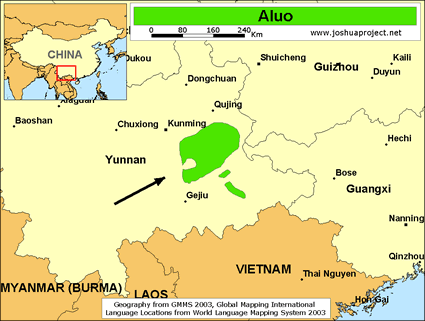

The Aluo are a small ethnic minority living primarily in Shizong and Luliang counties in eastern Yunnan Province, China. Although officially classified by the Chinese government as part of the larger Yi nationality, the Aluo maintain a distinct identity, oral tradition, and language. Their language belongs to the Tibeto-Burman branch of the Sino-Tibetan language family and is related to other Yi languages spoken throughout Yunnan.
The Aluo trace their origins to a legendary cultural hero named Ah-luo, from whom they take their name. According to their traditional stories, Ah-luo possessed extraordinary strength and rescued humanity from suffering by destroying excess suns and moons that scorched the earth. Other accounts describe him defeating destructive monsters that threatened mankind. These stories remain deeply connected to Aluo identity and spiritual life. Neighboring peoples often refer to them as the Hong Yi, or "Red Yi," because of the dominant color in their traditional clothing.
Like many minority groups in Yunnan, the Aluo have historically lived in mountainous rural communities where traditions, clan ties, and oral heritage have remained strong. Their communities have received little outside Christian witness compared to some other ethnic groups in southwest China.
Most Aluo live in agricultural communities scattered across the hills and valleys of eastern Yunnan. Farming shapes daily life, with families depending on crops, livestock, and seasonal labor for survival. Extended family relationships are important, and village life is often organized around kinship ties and long-standing community customs. Homes are generally simple and built to fit the mountain environment.
Traditional festivals continue to play an important role in preserving Aluo identity. One of their best-known celebrations occurs every twelve years during the Year of the Horse, when the community gathers for the Paying Tribute to Ah-luo Festival. The ceremony includes ritual processions, sacrifices, prayers, and symbolic displays connected to their ancestral traditions. Pine and fir trees are arranged in ceremonial patterns representing the passing of years and the continuity of the people.
Traditional clothing, music, storytelling, and oral history remain valued parts of Aluo culture. Like many minority peoples in Yunnan, the Aluo have faced pressures from modernization, migration, and economic hardship, especially among younger generations who may leave rural areas seeking work in larger towns and cities.
The Aluo primarily follow ethnic folk religion centered on reverence for Ah-luo and various spiritual powers associated with nature, ancestors, and the unseen world. Their traditions include ritual offerings, ceremonial sacrifices, chants, and the ministry of shamans who guide religious ceremonies and attempt to communicate with spiritual forces.
During major festivals, shamans wear ceremonial garments and lead prayers at altars dedicated to Ah-luo. Ritual objects and symbolic structures are used to represent spiritual realities and ancestral presence. These practices reflect a worldview in which daily life is closely connected to spirits, blessing, protection, and fear of unseen powers.
The Aluo's spiritual identity is strongly tied to their ethnic identity, making conversion to Christianity socially difficult. Very few Aluo have heard a clear presentation of the gospel, and there is little known Christian witness among them.
The Aluo need faithful access to the gospel in their own language and cultural context. Many have little or no understanding of Jesus Christ or the message of salvation found in Scripture. Because their traditions are deeply woven into community life, those who show interest in Christianity may face social pressure or isolation.
They also face practical challenges common to many rural minority communities in southwest China, including limited economic opportunity, uneven access to healthcare, and educational barriers in remote areas. Younger generations often leave their villages for work, creating social and family strain.
The Aluo would benefit from Scripture translation work, long-term Christian discipleship, compassionate medical and educational assistance, and believers willing to live among them with humility and perseverance. There is also a great need for mature Chinese Christians and nearby believers to carry the gospel to Aluo communities.
Pray that the Aluo people would encounter the truth of Jesus Christ and turn from fear of spirits and ancestral bondage to the living God.
Pray that workers equipped with wisdom, humility, and love would be sent to live among the Aluo and faithfully share the gospel.
Pray that the Aluo people would be adopted through the People Group Adoption program, so they receive sustained prayer, long-term gospel engagement, and ongoing discipleship efforts.
Pray that any existing believers in and around Aluo communities would grow strong in faith and boldly share Christ with neighboring peoples throughout Yunnan Province.
Scripture Prayers for the Aluo in China.
https://people-groups.asiaharvest.org/China/chinaPeoples/A/Aluo.pdf
https://peoplegroups.org/people_groups/pg006660/
https://en.wikipedia.org/wiki/Aluo_language
| Profile Source: Joshua Project |