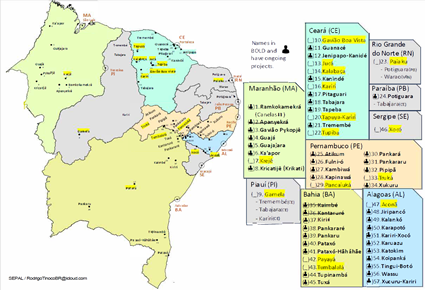
The Pankara are an Indigenous people of northeastern Brazil, living primarily in the interior of the state of Pernambuco, near the border with Bahia. Their territory is part of a semi?arid region shaped by dry seasons, scrub vegetation, and limited water sources. Portuguese is widely spoken today, though Pankara identity remains deeply tied to shared ancestry, territory, and communal memory.
Historically, the Pankara endured land loss, social marginalization, and pressure to assimilate into surrounding society. Despite these challenges, they preserved a distinct identity rooted in kinship, ritual life, and attachment to ancestral land. Contact with churches, schools, and government structures introduced new influences, but these have coexisted with older patterns of belief and community organization.
Pankara life revolves around extended family networks and shared responsibility. Households often work together to meet daily needs, relying on small?scale farming suited to dry conditions, animal care, and occasional wage labor outside the community. Life requires adaptability, as families respond to environmental limits and economic uncertainty.
Meals are typically simple and shared, reinforcing cooperation and mutual dependence. Elders are respected as carriers of knowledge and play an important role in guiding family and community relationships. Much learning happens informally, through observation and participation in daily tasks.
Community gatherings remain central to social life. Family milestones, traditional ceremonies, and church activities bring people together for shared meals, music, and conversation. These moments help sustain identity and social cohesion in the face of ongoing change.
Traditional Pankara spirituality remains prominent and centers on faith in a spirit?inhabited world believed to govern health, fertility, rainfall, and protection from harm. Spiritual beings and forces are understood to be active in daily life, and ritual practices are used to seek balance, healing, or guidance. These beliefs represent sincere trust placed in the spirit world rather than in human effort alone.
At the same time, the gospel has a visible presence among the Pankara. Christian witness exists through churches and individual believers, and some families identify as followers of Jesus Christ. While Christianity has not replaced traditional religion for most, there is a genuine gospel foothold that continues through relationships, testimony, and teaching.
The Pankara face lasting challenges related to healthcare access, food security, and economic stability in a difficult environment. Longstanding marginalization continues to affect opportunities for education and employment, especially for younger generations.
Spiritually, the Pankara need continued and compassionate gospel witness that clearly presents salvation through Jesus Christ alone. Many place their hope in spiritual forces that cannot bring forgiveness of sin or lasting peace with God. Those who have begun following Christ need encouragement, Scripture?based teaching, and discipleship so their faith can grow deep and resilient. The community needs emerging local believers who can share the gospel with clarity within their own cultural setting.
Pray for physical provision and endurance for Pankara families.
Ask God to soften hearts toward the gospel among those trusting in spiritual powers.
Pray for new believers to grow strong through Scripture and discipleship.
Ask the Lord to raise up faithful Pankara Christians who can lead and teach others.
Pray that the gospel presence among the Pankara will continue to grow with clarity and power.
Scripture Prayers for the Pankara in Brazil.
https://en.wikipedia.org/wiki/Pankará
https://en.wikipedia.org/wiki/Indigenous_peoples_in_Brazil
https://www.britannica.com/place/Pernambuco-state-Brazil
| Profile Source: Joshua Project |