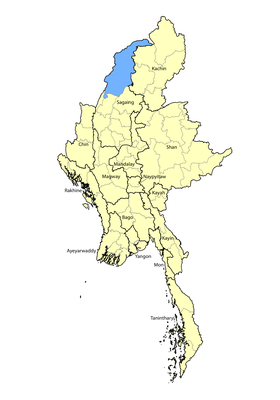

Makury Naga people live along a strip of land straddling the Myanmar-India border in the far west of the country. Most inhabit 12 villages within Leshi Township, with a few villages in each of Lahe and Homalin townships. Makury territory "is rugged and rocky with deep valleys and swift streams. Due to the mountainous terrain, transportation and communication are a challenge."1 An additional Makury people live in the Indian state of Nagaland, concentrated in Kiphire and Phek districts. A succession of towering peaks and treacherous canyons on both sides of the border mean that the Makury in each country have little contact with one another.
The tribe is said to be related to the Longphuri Nagas, with whom they often share the same villages. Significant historic and cultural differences exist, however, and in turn, both the Makury and Longphuri Nagas acknowledge historical kinship with the large Yimchungra tribe across the border in Nagaland.
All the people have positive attitudes toward their mother tongue, and children are learning Makury as their first language."2 One source has suggested there are 40,000 speakers of Makury in Myanmar and 25,000 in India,3 but these extremely high numbers are not supported by other research.
The Makury "trace their origins back to the village of Kiusukiuin in present-day Nagaland at least ten generations ago, according to tradition."5 From there, they sent out colonies to the Myanmar border area. Although the Makury and Longphuri Nagas are neighbors today, in 2019 a tribesman said the strife between the two groups "dates back to headhunting times when the Makury were forced to flee their villages and find refuge in Longphuri villages. Now, because they are more numerous, the Makury pose a threat to the Longphuri by banning their language and traditional dance."6
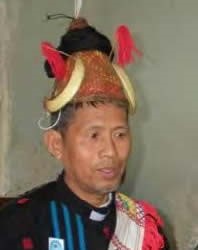
Many tribes in Myanmar have traditional tattoos, but the Makury designs were unique to them. Men "had human figures on their shoulders and various patterns of horizontal lines in zigzag patterns on the inner forearm…applied so fellow Makury could recognize them in the heat of battle."7 Makury women, meanwhile, were given face tattoos "as a rite of passage into the afterlife."8 One unique Makury belief is that eating dog meat will remove bad blood from a person's body and protect him against malaria. Most Makury Naga people live in villages where agriculture forms the foundation of daily life. Families cultivate rice, maize, vegetables, and other crops, while some engage in animal husbandry, trade, or wage labor. Meals commonly consist of rice accompanied by vegetables, beans, and meat when available.
Seasonal festivals and gatherings provide opportunities for families and neighbors to celebrate together, share meals, and strengthen social bonds. Younger generations increasingly pursue education and employment opportunities beyond their villages while maintaining ties to their communities and heritage.
A 2011 report noted that 90 percent of Makury people were Christians, with Buddhists and animists each claiming five percent of the population.9 As Nagas in the area rejected their animistic beliefs, they embraced both Christianity and Buddhism, "thanks to contact with western Naga tribes (Baptists), Kachin missionaries (Catholics), American missionaries (Church of Christ), and Burmese Buddhists. This trend caused them to discard traditions that were difficult to reconcile with their new faith. Each case of proselytization needed to be approved by the village chief."10
The gospel was first proclaimed among the Makury people in 1950. Early progress was painstakingly slow, with new believers often being severely persecuted and ostracized, as tribal leaders feared the new faith would upset the spirits and bring calamity upon their community. Today, 90 percent of Makury people in Myanmar are Christians, with most belonging to Baptist and Revival churches. The Makury New Testament was published in 2018, and having God's word in their heart language has established the faith of many believers who previously used Burmese Bibles.
Remote villages often experience limited access to healthcare, transportation, and educational opportunities. Economic development and improved infrastructure would help strengthen families and communities. Greater access to quality schools and medical services would benefit children and adults alike. Churches would benefit from well-trained leaders who can teach Scripture faithfully and equip believers for mature Christian living. Opportunities exist for Christians to deepen their understanding of God's Word and to develop ministries that address both physical and spiritual concerns. The strong Christian presence among the Makury Naga provides a foundation from which believers can participate in sharing the gospel with neighboring peoples who have less access to biblical teaching.
Pray that God will provide better access to healthcare, education, and economic opportunities for Makury Naga communities.
Pray that pastors and church leaders will be equipped to teach the Scriptures faithfully and disciple younger generations.
Pray that believers will grow in spiritual maturity and demonstrate the love of Christ in their families and villages.
Pray that Makury Naga Christians will become part of God's global discipleship force and help bring the gospel to less reached peoples throughout Myanmar.
Scripture Prayers for the Naga, Makury in Myanmar (Burma).
Asia Harvest
1 SIL, "The Makuri Naga People of Myanmar," Unpublished report, 2011.
2 SIL, "The Makuri Naga People of Myanmar."
3 https://en.wikipedia.org/wiki/Makury_language
4 Summer Institute of Linguistics, Ethnologue: Languages of the World (27th edition, 2024), online version.
5 J. D. Saul, The Naga of Burma: Their Festivals, Customs, and Way of Life (Bangkok: Orchid Press, 2005), p. 25.
6 Olk Bon, Culture Change among the Naga Tribes of Myanmar: The Former Headhunters Seek to Modernize (Coppell, TX: Self-published, 2019), pp. 11-12.
7 Saul, The Naga of Burma, p. 38.
8 See https://www.dylangoldby.com/tattoos-of-asia/toa-tribes/makuri-naga-sagaing-division-myanmar/
9 SIL, "The Makuri Naga People of Myanmar."
10 Bon, Culture Change among the Naga Tribes of Myanmar, p. 12.
| Profile Source: Joshua Project |
| Other PDF Profile |