

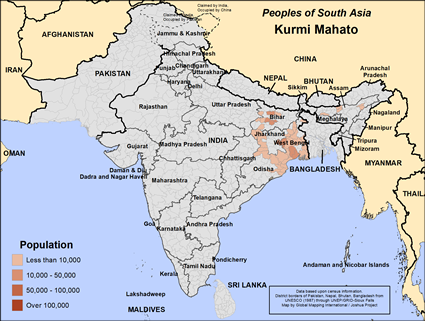
The Kurmi Mahato are an agricultural community found primarily in Jharkhand, West Bengal, Odisha, Bihar, and neighboring regions of eastern India. They are part of the broader Kurmi farming tradition of India, while the title "Mahato" historically referred to village headmen, landholders, or respected agricultural leaders in many eastern Indian communities. Most Kurmi Mahato people speak regional languages such as Bengali, Hindi, Kurmali, Odia, or related dialects depending on location. Their identity has long been connected to farming, village leadership, and strong ties to the land.
Historically, the Kurmi Mahato were known as hardworking cultivators and rural agriculturalists. Many communities developed around farming villages where seasonal agriculture shaped daily life, family structure, and local customs. In some regions, Mahatos held positions of influence within village administration and community affairs. Over generations, social and economic changes led many younger Kurmi Mahato to seek work in education, transportation, government service, mining, business, and urban employment, though agriculture remains central for many families. (en.wikipedia.org)
The Kurmi Mahato have preserved strong community networks, clan relationships, and regional cultural traditions despite modernization and migration. Folk songs, harvest celebrations, and village festivals continue to play important roles in maintaining social identity and family connections.
Most Kurmi Mahato families are connected in some way to agriculture, farming labor, livestock care, or village-based occupations. Some cultivate rice, wheat, vegetables, pulses, or other regional crops, while others work in transportation, mining, construction, factory labor, government service, or small business. Economic conditions vary significantly between households. Families with farmland may experience greater stability, while landless laborers and poorer rural families often face financial uncertainty and seasonal hardship.
Family and community ties are highly valued. Extended families commonly remain close, and marriages are usually arranged within accepted social and clan boundaries. Village elders and community leaders may still help settle disputes and preserve customary practices. Respect for elders, family honor, and cooperation during agricultural seasons remain important parts of social life.
Meals commonly include rice, lentils, vegetables, fish, flatbreads, and locally available foods typical of eastern India. Religious festivals, harvest celebrations, weddings, and village gatherings remain important social events that strengthen cultural identity. In some rural regions, educational access and healthcare infrastructure remain limited, though younger generations increasingly pursue education and employment opportunities in cities and industrial areas.
The Kurmi Mahato primarily follow Hinduism mixed with local folk religious traditions common in eastern India. Worship commonly includes devotion to Hindu gods and goddesses such as Shiva, Durga, Kali, Vishnu, and regional village deities associated with fertility, harvests, protection, and family well-being. Religious life often includes temple worship, offerings, household rituals, festival observances, and ceremonies connected to births, marriages, and funerals.
In many communities, folk beliefs involving ancestral spirits, sacred groves, astrology, ritual purity, and supernatural protection remain influential alongside formal Hindu worship. Seasonal agricultural rituals may also be performed in hopes of securing rain, healthy crops, and protection from misfortune. Belief in karma and rebirth strongly shapes worldview and moral understanding.
Although Christianity is present in parts of eastern India, many Kurmi Mahato still have limited understanding of the biblical gospel. Jesus may be viewed simply as another holy teacher or religious figure rather than the crucified and risen Son of God who alone provides forgiveness of sins and reconciliation with God. Clear biblical teaching and long-term discipleship remain limited in many Kurmi Mahato communities.
The Kurmi Mahato need continued access to quality education, healthcare, vocational training, and stable economic opportunity, especially in rural areas where farming incomes can be uncertain. Agricultural debt, seasonal hardship, and limited infrastructure continue to affect many villages. Young people migrating to cities for work also face pressures related to unstable employment, housing, and separation from traditional support systems.
Spiritually, the Kurmi Mahato need faithful gospel witness communicated clearly in their own languages and cultural settings. Many have never heard a biblical explanation of repentance, grace, forgiveness, and eternal life through Jesus Christ. Strong local churches, Scripture access, discipleship, and relationship-based ministry are needed so Kurmi Mahato families can clearly hear and respond to the gospel. Existing believers in eastern India also need encouragement and biblical training so they can faithfully reach neighboring agricultural communities with biblical truth.
Pray that the Kurmi Mahato people will hear and understand the gospel clearly in their own languages and place their faith in Jesus Christ.
Pray that God will raise up mature local believers and church leaders who can disciple Kurmi Mahato families and establish biblically faithful churches among them.
Pray that Kurmi Mahato communities facing agricultural hardship, limited educational opportunities, healthcare challenges, and economic uncertainty will experience practical help and lasting hope.
Pray that the Kurmi Mahato people will be adopted through the People Group Adoption program so that ongoing prayer, evangelism, discipleship, and church planting efforts will continue among them.
Scripture Prayers for the Kurmi Mahato in India.
https://en.wikipedia.org/wiki/Kurmi
https://www.britannica.com/topic/Kurmi
https://peoplegroups.org/explore/GroupDetails.aspx?peid=41613
https://www.india.gov.in/topics/agriculture
| Profile Source: Joshua Project |