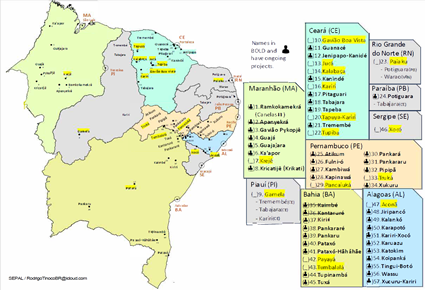
The Gamela are an indigenous people of northeastern Brazil, historically concentrated in the state of Maranhão. Their name likely derives from the Portuguese word for "wooden bowl," a reference to the distinctive lip discs traditionally worn by members of the group. During the colonial era, the Gamela were known as fierce resisters of Portuguese expansion, engaging in significant conflicts with colonizers and neighboring indigenous groups throughout the 17th and 18th centuries.
Following centuries of violent contact, forced displacement, and assimilation pressures, the Gamela were long considered extinct as a distinct people. However, beginning in the late 20th century, descendants in Maranhão began a process of ethnic resurgence, publicly re-identifying as Gamela and seeking recognition of their indigenous identity and ancestral land rights. This reassertion has been met with both support from indigenous rights organizations and resistance from local landowners, leading to ongoing tensions and, at times, violent confrontations over land.
The Gamela today live primarily in rural communities in the baixada maranhense (lowlands of Maranhão), an area characterized by seasonal flooding, palm forests, and subsistence agriculture. Most families engage in small-scale farming, cultivating crops such as manioc, rice, and beans. Fishing and the harvesting of babaçu palm nuts are also central to their livelihood, with palm oil and palm-derived products providing both food and a modest source of income.
Housing is typically simple, constructed from mud, wood, and palm thatch. Access to healthcare and education remains limited in many Gamela communities, and infrastructure such as roads and electricity can be unreliable. Socially, the Gamela maintain close-knit extended family networks, and community decisions are often made collectively. Their ongoing struggle for legal recognition of their territory defines much of contemporary Gamela life, as land conflicts with ranchers and farmers have led to cycles of displacement and uncertainty.
The Gamela historically practiced traditional animistic beliefs, venerating spirits associated with the natural world—forests, rivers, and animals—and observing rituals tied to agricultural cycles and community life. Shamanic figures played important roles in mediating between the human and spirit worlds.
Today, due to centuries of contact, much of the original Gamela religious tradition has been lost or syncretized with Catholicism, the dominant religion of the region. Many Gamela identify as Catholic and participate in the religious festivals and saint devotions common to rural Brazilian society. Elements of folk Catholicism, blended with residual indigenous and Afro-Brazilian spiritual practices, may still be present in some communities.
The Gamela face significant challenges on multiple fronts. Legally, their status as an indigenous people has been contested, complicating efforts to secure land rights and government protections. Violent clashes with landowners have resulted in injuries and trauma within the community. Economically, poverty is widespread, and access to healthcare, quality education, and clean water is inconsistent.
Spiritually, the Gamela have little access to the gospel in a way that speaks to their unique cultural identity and historical experience. They need the hope and transformation that only Jesus can bring—hope that addresses not only their practical struggles but also their search for identity, justice, and reconciliation. There is a deep need for believers who will walk alongside the Gamela with patience, respect, and a commitment to holistic ministry.
Pray for the physical safety and protection of Gamela communities amid ongoing land disputes and social tensions.
Pray for access to clean water, adequate healthcare, and improved educational opportunities for Gamela children and families.
Pray that Brazilian believers and mission agencies would be stirred to reach out to the Gamela with the love of Christ in culturally sensitive ways.
Pray for the emergence of a Gamela-led movement to faith in Jesus, with Scriptures and worship expressed in forms meaningful to their heritage.
Pray that the Gamela would be adopted through the People Group Adoption program, ensuring ongoing prayer and intentional engagement for gospel impact among them.
Scripture Prayers for the Gamela in Brazil.
https://www.culturalsurvival.org/
https://pib.socioambiental.org/en/Povo:Gamela
| Profile Source: Joshua Project |