


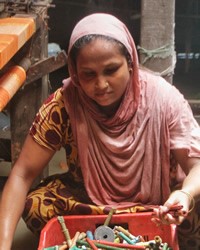

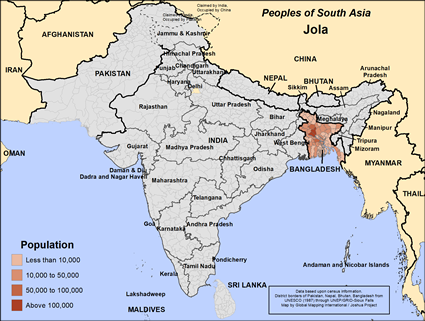
Jola live among a large number of Bengali-speaking peoples. They live in Bangladesh, especially the states of Rajshahi and Dhaka. There is a small number living in other parts of Bangladesh.
Like many rural communities in Bangladesh, their work life is generally focused on subsistence activities, including farming, day labor, and small trades. Although the profile does not list a single specialized occupation, their integration among wider Bengali society suggests that they often participate in agriculture, manual labor, and informal economic work common in these regions.
Their daily work is typically labor-intensive and family-oriented, with men often working in fields or wage labor while women contribute through household production, small-scale farming tasks, or cottage industries. Because they live in densely populated rural areas, many Jola workers also depend on seasonal employment, which can make income unstable.
Because of their economic situation, recreation tends to be low-cost and community-based, rather than involving expensive or private entertainment. They spend much of their free time talking with friends, listening to music, and telling stories for entertainment.
Jola people are almost entirely Sunni Muslim, and as far as we know, there are no Christ followers among them. Like most Muslims in South Asia, the Jola people put their faith in their obedience to the teachings of the Koran for their eternal salvation, but they look to local spirits for their daily needs. They do not understand that they need a Savior to pay for their sins if they are going to be in good standing with the Almighty.
The Jola face several important economic challenges tied to their environment and social position.
First, they need greater economic stability and access to consistent employment. Many rely on irregular or seasonal work, so dependable income opportunities would significantly improve their quality of life.
Second, they have a need for improved agricultural resources and training, such as better tools, irrigation systems, and access to markets. These improvements could increase productivity and help them move beyond subsistence living.
Third, education and skill development are important needs. Increased access to schooling and vocational training would allow younger generations to pursue a wider range of occupations beyond manual labor.
Finally, they need basic infrastructure and services, including healthcare, clean water, and transportation, which are often limited in rural Bangladesh.
Pray for the Lord to thrust out workers to help the Jola find their way to salvation through faith in Jesus Christ.
Pray that the Lord would put them into contact with Christian audio and visual resources.
Pray for a movement of Jola disciples who make other disciples who then make even more disciples.
Pray that people of peace would be found who will be instrumental in planting churches among Jola.
Pray for a vibrant Jola-based Church to begin in Bangladesh soon.
References
Scripture Prayers for the Jola in Bangladesh.
| Profile Source: Joshua Project |


