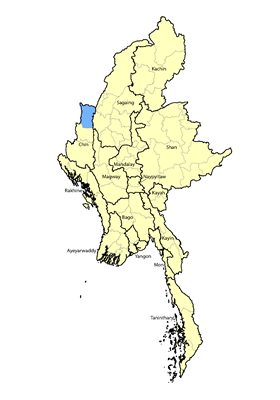

Members of the Vangteh tribe inhabit four villages (Vangteh, Pakzang, Tuizang and Mualzang) in a narrow valley in Myanmar's northern Chin State, about 20 miles (32 km) south of Tedim Township. Their area, which stretches about halfway across the width of the state from east to west, is bordered by five different tribes: the Teizang, Saizang, Dim, Khuano, and Siyin. The topography in this part of Myanmar is formed by "the giant Himalayas to the north, which form the background and source of this whole mountainous area. These spurs are themselves ranges of rugged mountains, rising 5,000 to 10,000 feet (1,520 to 3,040 meters) above sea level."
Although the village of Vangteh has played a prominent role in the history of several tribes, the Vangteh are a distinct people and language group that has never been documented before by Christian researchers. While the Vangteh people willingly acknowledge historical and linguistic connections to other tribes in the Tedim area, they possess a shared history and a proud sense of tribal identity and culture.
Little is known of the Vangteh vernacular and how it relates to other languages in the area, although Vangteh has been identified as a distinct variety in recent linguistic studies, including on a language map of Chin State produced by the Language and Social Development Organization. Further research is required to determine how Vangteh relates to other Chin varieties.
Vangteh history dates back at least as far as Gui Mang I, who founded the city-state of Ciimnuai in about AD 1050. Later, a Guite chief named Gen Dong established Vangteh as his political center and extended his rule south and west, crossing the Manipur River into today's India. Over time, Guite authority expanded to more than 53 towns and villages, and Vangteh village itself grew to contain more than 700 households. Today's Vangteh people are one of the last remnants of the former Guite city-state, which influenced the area for 600 years from about 1300 to 1900. During the Second World War, the fierce, fighting character of the Vangteh saw them strongly resist Japanese occupation, even though other tribes in the area quickly surrendered.
Traditional Vangteh customs were reevaluated after Christianity swept through their communities in the 20th century. In 2000, a visitor observed: "The surviving remnants of old-time?tribal religion?keep their ancient rituals in the midst of the over-flooding?Christianity. Oral traditions such as sacred?incantation, traditional war songs,?nursery rhymes, and other?folk songs?are still in use by almost 100 households in Vangteh at the present time."
Although most Vangteh people today are followers of Jesus Christ, a concerted effort by some Vangteh people to preserve their traditional animistic religion meant that at the start of the new millennium, "there were still about 100 households who practice the ancient ancestor worship religion called Pu-sa. In 2002, permission to print limited copies of their sacred incantations was granted by the Myanmar government to help those who still practice this old-time religion in Vangteh."
Because the Vangteh have never previously been profiled as a separate people group, no Scripture or any other Christian resources have been translated into their language. It is likely the Vangteh believers use Tedim Chin Bibles. A revival deeply impacted the Tedim area from the early 1970s to the end of the last century. The movement "began with individual renewal among the Baptists, but resulted in numerical growth in Assemblies of God churches as believers experienced the power of the Holy Spirit." A crusade meeting in 1973 reportedly caused "people everywhere—in offices, in schools, at the marketplace, on the street—to discuss the issue of being born-again, which is salvation by faith alone. People were amazed at the new converts who had formerly been gang members, drunkards, and thieves, but who now showed a total turn-around in their lives. Some people admitted it was the work of the Holy Spirit, while others said it was the work of evil spirits."
Ask God to strengthen those who are sharing the gospel so they can do it with love and wisdom.
Pray for Vangteh hearts to be open and for whole families to experience peace and hope in Christ.
Pray for revival fire to spread uncontrollably from family to family.
Pray for Vangteh Christians to excel in love, joy, and peace as they take Christ to others.
Pray for their leaders to listen to the Lord, hear him, and obey him.
Scripture Prayers for the Vangteh in Myanmar (Burma).
Asia Harvest, Copyrighted 2026 © Used with permission
| Profile Source: Joshua Project |
| Other PDF Profile |