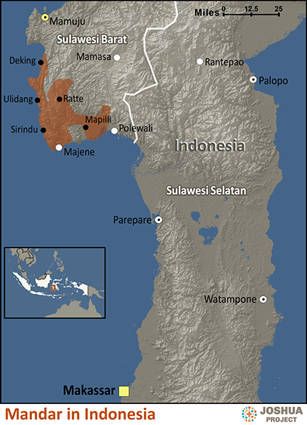

The Mandar are an ethnic group native to the province of West Sulawesi in Indonesia. They are one of the major peoples of Sulawesi and are closely related to the Bugis, Makassarese, and Toraja peoples. The name "Mandar" historically refers to a federation of seven coastal kingdoms and seven inland kingdoms that formed alliances for mutual protection, trade, and governance. This political and cultural union helped shape a strong Mandar identity that continues today. Their primary language is Mandar, an Austronesian language with several regional dialects, although Indonesian is also widely spoken.
For centuries, the Mandar have been known as both agriculturalists and skilled seafarers. Their location along the Makassar Strait encouraged maritime trade, fishing, and boatbuilding. Historically, Mandar communities developed along both the coastal plains and the mountainous interior of West Sulawesi. Despite modernization, many still maintain a strong connection to their traditional customs, regional history, and ancestral lands.
Many Mandar families earn their livelihood through rice cultivation, fishing, coconut farming, cocoa production, and small-scale trade. Coastal communities are especially known for fishing and maritime activities, while inland communities are more dependent on agriculture. The fertile valleys and irrigated rice fields of West Sulawesi support a substantial farming economy.
Mandar society has traditionally recognized social distinctions that originated during the era of the regional kingdoms. Nobility, commoners, and descendants of former servant classes historically occupied different social positions, although these distinctions have become less significant in modern Indonesia. Family relationships remain strong, and extended families often provide support during times of need. Education is increasingly valued, and many younger Mandar pursue opportunities in business, government service, education, and other professions.
The Mandar are also known for their cultural traditions, including weaving, boatbuilding, music, and community festivals. Hospitality is highly regarded, and family gatherings, weddings, and religious celebrations remain important parts of community life. Traditional foods commonly include rice, fish, coconut-based dishes, and locally grown fruits and vegetables.
The Mandar are overwhelmingly Muslim and have identified with Islam for centuries. Islamic beliefs and practices shape much of their community life, including prayer, fasting during Ramadan, mosque attendance, and observance of Islamic festivals. Islam serves as a central component of Mandar identity and culture.
At the same time, traditional animistic beliefs continue to influence many aspects of life. Belief in spirits, sacred places, supernatural powers, and occult practices remains common in some areas. Many people seek help from dukun, or traditional shamans and healers, for healing, protection, guidance, and spiritual matters. Ritual practices involving offerings, incense, and traditional ceremonies often reflect a blending of Islamic belief with older animistic traditions. This syncretism has made it difficult in some cases to distinguish between Islamic practice and pre-Islamic spiritual customs.
Most Mandar have had little opportunity to hear a clear explanation of the biblical gospel. While some Scripture portions are available in their language, access to evangelical Christian teaching and discipleship remains very limited.
The Mandar need greater access to the gospel through trusted relationships, Scripture resources in their heart language, and mature believers who can communicate biblical truth in culturally understandable ways. Their strong Islamic identity, combined with longstanding traditional spiritual beliefs, can make meaningful gospel engagement challenging and often requires patience and long-term relationship building.
Many Mandar communities also face practical needs related to economic development, agricultural productivity, fishing industries, education, and employment opportunities for younger generations. Rural communities may benefit from improved access to vocational training, sustainable agricultural practices, and business development opportunities. Meeting practical needs with compassion can help open doors for meaningful relationships and ministry.
Above all, the Mandar need opportunities to encounter Jesus Christ through God's word, understand the message of salvation by grace through faith, and see transformed lives through the witness of faithful believers and healthy local fellowships.
Pray that the Mandar would have many opportunities to hear a clear presentation of the gospel and understand the saving work of Jesus Christ.
Pray that God would raise up faithful workers who will build genuine relationships among the Mandar and communicate biblical truth with wisdom, humility, and love.
Pray that the Mandar would be adopted through the People Group Adoption program so that churches and believers will commit to ongoing prayer, outreach, and future gospel engagement among them.
Pray that the small number of Mandar believers would be strengthened in their faith and equipped to share the gospel with their own people and neighboring ethnic groups throughout Sulawesi.
Scripture Prayers for the Mandar in Indonesia.
https://en.wikipedia.org/wiki/Mandarese_people
https://en.wikipedia.org/wiki/Mandar_language
https://www.prayingforindonesia.com/ethnic-groups/the-people-of-sulawesi/who-are-the-mandar/
https://www.jurnal.stainmajene.ac.id/index.php/iceil/article/download/469/263
https://www.encyclopedia.com/humanities/encyclopedias-almanacs-transcripts-and-maps/bugis-makassarese-and-mandarese
| Profile Source: Joshua Project |