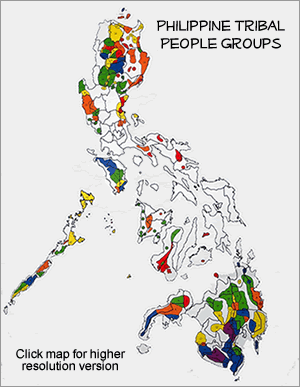

The Adasen are one of nine subgroups of the Itneg people — also called Tinguian — a Cordilleran indigenous group of the mountains of Abra Province in northern Luzon, Philippines. The Adasen take their name from the Adasen River valley, and their communities are concentrated primarily in the municipalities of Lagayan, Lagangilang, and Tineg in northeast Abra Province, extending into parts of western Apayao Province. Their language, Adasen, is an Austronesian tongue within the Philippine language family. Many Adasen also speak Ilocano and Isnag as second languages, reflecting the long contact between Itneg communities and their lowland neighbors.
The name Itneg is believed to derive from an Ilocano phrase meaning "the interior," reflecting the circumstances of their history. Before Spanish colonization, Itneg ancestors lived closer to the coasts of northern Luzon. The advance of Spanish missionaries and Christianized Ilocano populations drove many Itneg communities inland into the Abra Valley and surrounding highlands during the sixteenth and seventeenth centuries, where they maintained their independence and distinctive way of life against colonial pressure. Spanish Augustinian missionaries eventually entered the Abra mountains and converted portions of the broader Tinguian population, leaving a Catholic presence that persists today. The Adasen territory of Tineg, the northernmost municipality of Abra, remains one of the most remote and difficult to access areas of the province, a factor that has helped preserve Adasen language, culture, and traditional beliefs while also limiting access to education and services.
The Adasen are primarily subsistence farmers, cultivating rice as their principal crop through both wet-rice terracing — where hillside paddies are irrigated by streams diverted through ditches — and dry swidden fields on higher slopes. Corn, sweet potato, camote, yams, and vegetables supplement the rice harvest, and sugarcane is grown to produce basi, a fermented wine consumed at communal gatherings and ritual ceremonies. Families hunt deer, wild pig, and birds using spears and snares, and freshwater fish — including eel, paleleng, and freshwater lobster — are caught in the rivers that run through Adasen territory. Pigs and chickens are raised and slaughtered primarily for ceremonial feasts and ritual occasions.
Villages are organized around clusters of family dwellings built near riverbanks, with rice granaries and vegetable gardens nearby. The lakay — an elder chosen by a council of respected community figures — serves as the village leader, settling disputes according to custom and calling the elders together for decisions that affect the whole community. Extended family and clan identity shape social life deeply, and obligations of mutual aid and ceremony flow along kinship lines. Weaving, the production of hand-woven cloth in geometric patterns, is an important art form practiced by women and worn on ceremonial occasions.
Music — played on the gangsa (copper gongs) and the kalaleng (nose flute) — accompanies celebrations. The great ceremonial feast, the cañao, marks the high points of Adasen social and spiritual life: births, marriages, harvests, healings, and community blessings are all occasions for multi-day gatherings involving animal sacrifice, communal feasting, singing, and dance.
Ethnic animism is the dominant spiritual framework among the Adasen, holding the allegiance of the great majority of the community. The Itneg traditional worldview centers on belief in a hierarchy of spirit beings — the anito, locally called sasailo — who encompass natural deities, leader spirits, and the spirits of deceased ancestors. These beings are both revered and feared, understood as active forces in health, harvest, and daily welfare. Spirits must be regularly appeased through offerings of food, wine, and animal sacrifice; failure to do so invites illness, crop failure, or other misfortune. The alopogan, a ritual specialist or shaman, serves as the community's intermediary with the spirit world, conducting healing ceremonies and communicating with ancestors. The Itneg also believe in a creator figure — Kabunian or Kadaklan — who dwells in the sky and who is regarded as a benevolent presence, approached through prayer and ceremony.
A minority of Adasen identify with Christianity, a legacy of the missionary work begun by Augustinian friars in the Abra highlands. The New Testament was translated into the Adasen language and published in 1990, placing the gospel in the heart language of the community. Evangelical believers are present, though they remain a small portion of the whole. For those who have come to faith, Jesus Christ offers the freedom from fear of spirits and ancestors.
The remote mountain terrain of northeast Abra and Tineg municipality limits the Adasen's access to secondary schooling, healthcare, and economic opportunities beyond subsistence farming. Roads into these communities are poor, making medical emergencies serious and reliable commerce difficult. Poverty and geographic isolation leave many Adasen families vulnerable, with little margin when harvests are poor or illness strikes. Spiritually, the large majority of the Adasen community has not yet turned from the spirit world to the living God, and the community of believers, while present, needs discipleship, pastoral care, and trained local leadership to grow and mature. The 1990 Adasen New Testament is a vital resource, but its distribution and use in a community with limited literacy require workers who will stay, teach, and build relationships over time. Cults active in the broader Abra region also pose a spiritual threat to younger believers seeking truth.
Pray that the Adasen will hear the good news of Jesus Christ and discover that his perfect love frees them from the fear of spirits that shapes so much of daily and ceremonial life.
Pray that Adasen believers will be strengthened in their faith and that God will raise up local church leaders who will disciple their own community and carry the gospel to other unreached Itneg subgroups across Abra.
Pray for improved access to healthcare, education, and economic opportunity for Adasen families in the remote communities of Tineg and surrounding areas.
Pray for the widespread distribution and diligent reading of the Adasen New Testament, and for workers with linguistic skill and long-term commitment to come alongside the Adasen community in the work of the gospel.
Scripture Prayers for the Itneg, Adasen Tinguian in Philippines.
https://en.wikipedia.org/wiki/Itneg_people
https://www.yodisphere.com/2022/09/Tinguian-Itneg-Tribe-Culture-Traditions.html
https://www.bahayugnayan.org/community-groups/abra
https://www.icbe.eu/cordillera-rituals-as-a-way-of-life/951-tingguian-abra-rituals
https://www.gutenberg.org/files/12849/12849-h/12849-h.htm
https://www.bible.com/languages/tiu
https://ncca.gov.ph/about-culture-and-arts/culture-profile/glimpses-peoples-of-the-philippines/tinguian/
| Profile Source: Joshua Project |