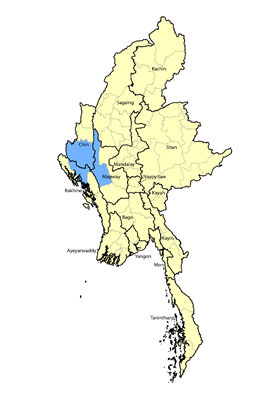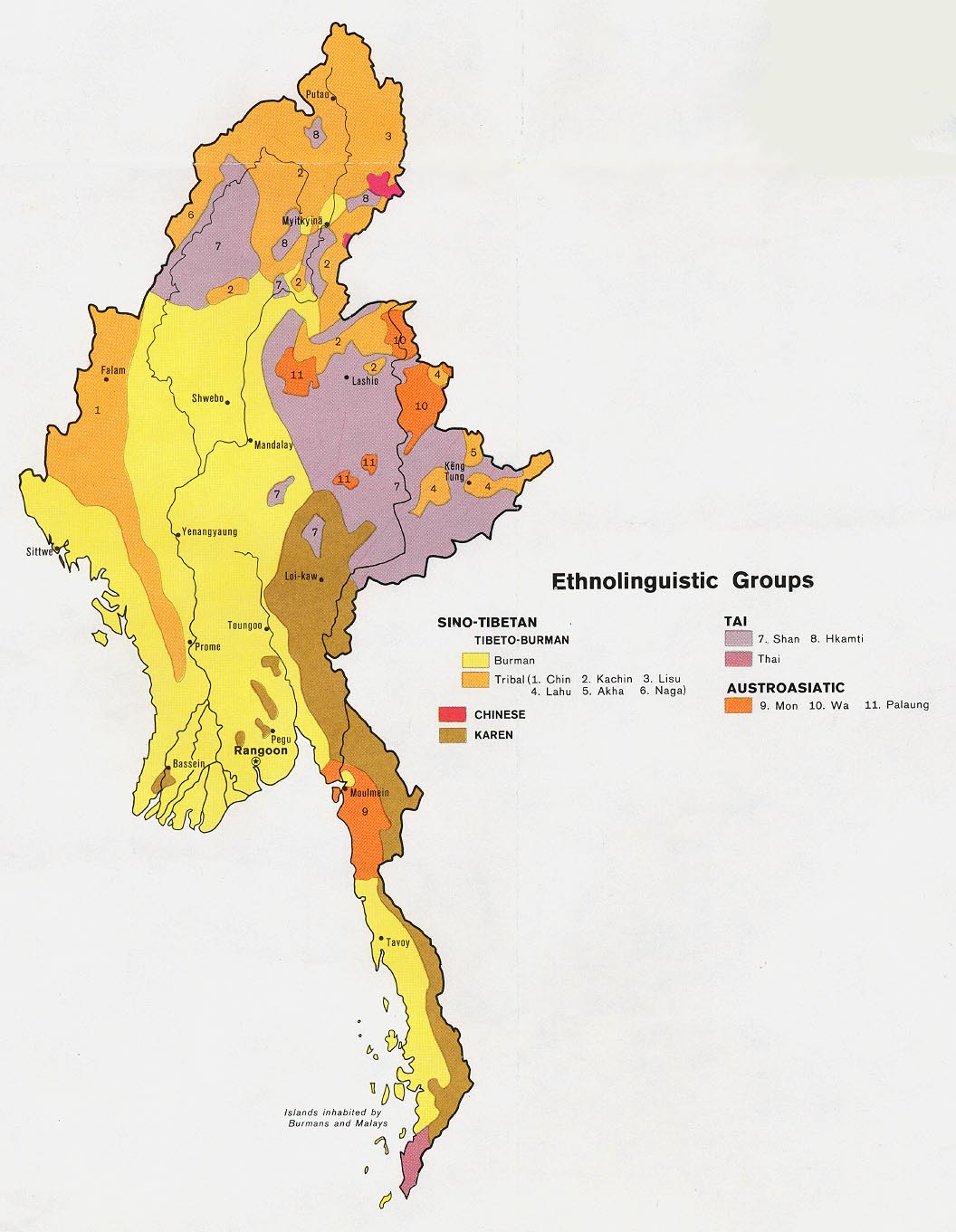

The Uppu tribe inhabits a relatively wide area across six townships and three states of central and western Myanmar. The majority reside in 22 villages and in the town of Kyin Dway in Chin State, where their territory is bordered by the Daai and Daa Yindu tribes to the north and the Songlai to the west. Significant numbers of Uppu people live further east in the Magway Region, while others spill across the border into northern Rakhine State.
The Uppu people have long been recognized as one of Myanmar's official ethnic groups, although not by their current name. The 1931 census returned 7,888 "Chinbon" people, 85 percent of whom were Buddhists and 15 percent animists. That percentage is little different today, making the Uppu one of the least Christian Chin tribes in the country.
All Uppu people can speak their tribal language, which is distinct from all other varieties in Myanmar. To communicate with other tribes, the Uppu must revert to Burmese. Studies suggest the closest language to Uppu is Asho Chin, but the two vernaculars share only a 50 percent lexical similarity, meaning they have only half of their vocabulary in common. In recent years an Uppu script was developed, primarily to lay the groundwork for the Uppu Christians to have their own Bible.
In the past the Uppu were engaged in constant tribal warfare and resistance against governing forces. Singing has always been a core part of life among all Chin-related tribes, with one scholar noting: "Songs are sung not only during feasts, but whenever there is a gathering. At the death of a child, the mother, the aunts, or the sisters recite, step by step, the child's life story. Likewise, kneeling beside the deathbed, village women recall in song, composed at the instant, the story of the death as they saw it. When a boy falls in love, he sings a song expressing his feelings to the girl, and the girl replies with a song."
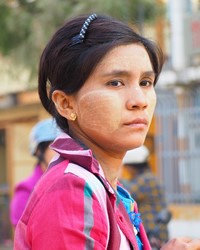
Uppu women's facial tattoos result in their entire faces being covered in dots, which gives them a dark appearance. Researcher Dylan Goldby wrote: "Their completely black faces may be what defines them at first sight, but the Uppu have maintained a different set of traditions to their neighbors over time…. The Uppu were known as great blacksmiths, a trade they learnt from outside. They had contact with some highly skilled blacksmiths, which can be seen from ladies' recollections of an iron tool that self-dispensed the ink as they were tattooed."
The Uppu are one of a handful of Chin-related tribes in Myanmar that are primarily Buddhist, although their faith is mixed with traditional Animism. Buddhism is stronger among Uppu communities in Rakhine State and the Magway Region, where they have been exposed to Buddhist Burmese and Rakhine people for many generations. The gospel has barely scratched the surface among the Uppu people, with the number of Uppu Christians estimated to be just 10 percent today.
At the time of the 1931 census, just two Uppu people identified as Christians out of the population of 7,888. While the situation has improved in recent decades, most Uppu have never heard the gospel in a way they can clearly understand. Leaders of the Revival Baptist Church first expressed a desire to have the Word of God in the Uppu language in 2004. A translation committee was formed and work commenced, but because Uppu was not a written language at the start, translating the Scriptures is a long and arduous initiative that is not scheduled to be completed until 2033.
Ask God to raise up Uppu leaders who can share the gospel with wisdom and compassion, bridging traditional beliefs and biblical truth.
Pray that the Uppu people would experience the love of Christ in ways that affirm their cultural identity and lead them to a closer walk with God.
Pray for them to have such a love for God that they can't help but tell others about him.
Pray for Uppu disciples to make more disciples.
Scripture Prayers for the Uppu in Myanmar (Burma).
Asia Harvest, Copyrighted 2026 © Used with permission
| Profile Source: Joshua Project |
| Other PDF Profile |