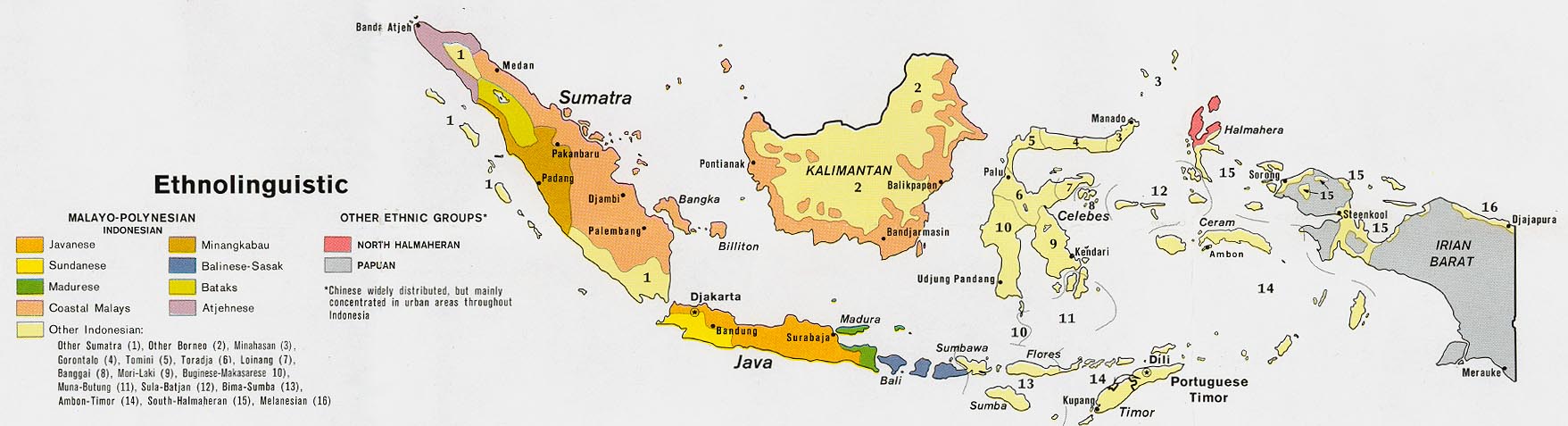
The Citak Asmat people call themselves Kau or Kaunak; "Citak" is an exonym reportedly given by neighboring groups. Their traditional homeland lies in the interior swamps and river-systems of what is now Mappi Regency in South Papua, Indonesia — in the upper reaches of the Brazza River and adjacent river systems.
Historically, the Kau lived in small, semi-nomadic villages scattered along rivers. Their life was shaped by the rhythms of forest and river: hunting, fishing, gathering sago, and seasonal movement as needed. In earlier times they did not organize themselves around clan-based social structures common among some neighbors; instead their social organization followed a matrilineal kinship system, and marriages were often matrilocal.
With external pressures—especially during the colonial era under the Dutch East Indies—there was a push to concentrate people into larger, more permanent villages. Over time, many Kau began to settle more permanently rather than maintain a semi-nomadic lifestyle, though their cultural identity remained tied to riverine, forest and swamp ecosystem.
Linguistically, the language spoken by the Kau belongs to the Asmat–Kamoro family within the Trans–New Guinea stock, under the subgroup often referred to as "Citak (or Kaunak) Asmat."
Among its dialects are those known as Citak proper, Tamnim, and Diuwe.
Over time, increasing contact with outsiders and Indonesian-language influence has affected their linguistic environment, and like other small language communities, their language faces challenges in intergenerational transmission.
Though the Kau share many cultural and linguistic affinities with the broader Asmat family, their path has been distinct: their relative interior location, their matrilineal organization, and their history of relocation have shaped a unique identity within the Asmat sphere.
In today's world the lives of the Kau remain deeply shaped by their forest and river environment. Their staple foods continue to include sago, complemented by fish, crustaceans, and hunted forest game such as wild boar, cassowary, and other wildlife when available. Sago processing and gathering remain tasks often associated with women, while men may hunt or fish using traditional dugout canoes.
Families are often extended, and kin relations remain important. Matrilineal inheritance and residence patterns historically meant that marriages and households were organized around women's lineages; even today this heritage influences how families relate, though change has come with settlement in permanent villages.
Cultural expression remains evident in their traditional arts. The Kau (Citak Asmat) are known for their woodcarving style, particularly in shield carvings and ceremonial objects whose motifs and designs reflect their identity and worldview. These crafts connect them not only to their ancestors and traditions, but also to other Asmat groups through related artistic forms.
Because many Kau now live in larger, more permanent villages rather than dispersed hamlets, there is more regular contact with outside society than in the distant past. Some younger people may have opportunities—however limited—for schooling, and some may engage in small-scale cash income through art, local trade, or occasional labor outside the village. Nonetheless, life remains challenging given remoteness, limited infrastructure, seasonal flooding, and dependence on subsistence activities.
Through all this, households maintain a deep relationship with their land and waters. Their identity continues to be rooted in the forest, river, and swamp — and the land remains central to their survival, family life, and cultural expression.
Among the Kau people today, most identify as Christians, with the faith having become a significant part of communal life. Churches now exist among the Asmat peoples, offering worship, teaching, and a sense of community that reaches beyond traditional village boundaries.
At the same time, elements of their ancestral religious worldview continue to influence beliefs among some individuals and families. Their traditional spiritual system recognized spirits dwelling in trees, rivers, and natural objects — and ancestral spirits connected to former generations played a powerful role in how they understood illness, death, social conflict, and the natural world.
Because of this heritage, many Kau Christians face a spiritual tension: on one hand they embrace the gospel and new faith in Christ, and on the other hand they carry memories and cultural patterns rooted in spirit-world thinking, ancestral veneration, and a relationship with land and nature that pre-dates Christian influence. Some may incorporate traditional practices alongside Christian worship; others may gradually move away from them.
Where Christian faith is established, there is often a desire for deeper discipleship, biblical teaching that resonates with their cultural context, and leadership that bridges their heritage with the gospel. In villages where Christianity has recently taken root, many still navigate the transition from traditional spiritual worldview toward a Christ-centered life.
The Kau people would benefit from improved access to basic infrastructure such as clean water, healthcare, transportation, and education. Their remote environment and seasonal flooding make access difficult, limiting opportunities for consistent schooling and medical care. Young people often lack access to stable employment or alternatives beyond subsistence, which affects their long-term prospects and can lead to economic hardship or drift.
Culturally sensitive economic opportunity is also needed: their traditional craftsmanship, especially wood carving, holds potential — but markets, fair trade, and training could help these artisans earn a sustainable living without abandoning their heritage. Supporting their crafts in ways that respect their identity could provide income while preserving tradition.
Spiritually, many Kau believers and communities need strong, well-trained local leadership. Pastors and Christian workers who understand the Kau cultural context and speak or at least appreciate their language and worldview are essential. In addition, resources for discipleship — especially Scripture, teaching materials, and small-group or community-based Bible study — would help believers grow deeper in their faith. For villages where the gospel is not yet firmly rooted, skilled evangelistic workers who can enter with humility, cultural respect, and a genuine love for the people are still very much needed.
Finally, intergenerational transmission of language and culture is at risk. As young people encounter outside influences, there is a real danger that the Citak language and traditional practices may decline. Efforts to support language preservation, cultural education, and respectful integration of Christian faith with traditional identity would help safeguard the full heritage of the Kau people for future generations.
Please pray that the Kau people will know true and lasting transformation through faith in Jesus Christ. Pray that local believers will grow in spiritual maturity and that churches among them will become anchors of hope, love, and unity in their communities.
Pray that God would raise up local leaders — men and women — who both understand the Kau culture and walk in deep dependence on Him, so they can shepherd their people with wisdom and compassion. Pray for training, discipleship, and teaching materials to reach even the most remote villages.
Pray for physical provision: clean water, access to basic healthcare, education for children, and sustainable opportunities for income — especially through crafts and culturally appropriate enterprises. Pray that these needs will not be met in ways that destroy the forest and river environment that the Kau depend on.
Pray for the next generation. As outside influences change their world, pray that young Kau will hold fast to both their identity and their faith — that they may grow up speaking Kau/Kaunak, valuing their heritage, and following Christ.
Pray for unity and reconciliation as families and communities navigate the tension between ancestral ways and the gospel, asking that false beliefs and fears rooted in spirit-world traditions be replaced by the truth and freedom found in Christ.
Finally, pray that God would send workers — both local and from outside — with compassion, cultural sensitivity, and long-term commitment, so that the gospel may take deep root among the Kau, and believers may become part of a global discipleship force, living out Christ's love in word and deed.
Scripture Prayers for the Asmat, Citak in Indonesia.
Wikipedia. https://en.wikipedia.org/wiki/Citak_people
Wikipedia. https://en.wikipedia.org/wiki/Citak_language
Antoni, Alexander de. "Call Us Kau, Not Citak." Anthropos (Nomos Verlag) — discussion of ethnic consciousness and history of the Kau pe
| Profile Source: Joshua Project |