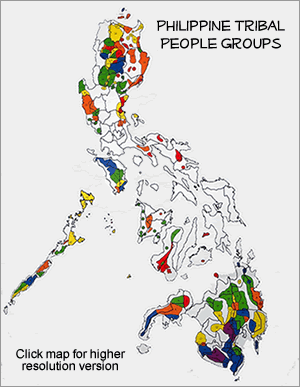
Among the Philippines' most ancient inhabitants are the Negrito peoples of Luzon — and the Kabulowan Dumagat are one of the lesser-known communities within this broader family. Also called the Southern Alta, they are a subgroup of the Dumagat, a name derived from the Tagalog word for "sea," though these communities are found not primarily along the coast but in the forested interior. Their homeland stretches across eastern Nueva Ecija, the Sierra Madre mountain range, the coastal areas of Quezon Province, and into the remote reaches of San Miguel, Bulacan. The Kabulowan language — also called Southern Alta — belongs to the Austronesian family but is linguistically distinct, sharing only modest similarity with its neighboring Alta dialects.
The Kabulowan are considered among the original inhabitants of the Philippine archipelago, predating the Austronesian migrations that populated much of the region. They belong to the Negrito peoples, distinguished by their physical features and their deep ancestral connection to the forests and rivers of Luzon. The name "Kabulowan" itself — alternately spelled Kabuluwen, Kaboloan, or Baluga — has been used both by outsiders and by the people themselves, though like many Negrito groups, they have navigated a complicated relationship with labels imposed from outside their community. Historically semi-nomadic, the Kabulowan moved through the forest in pursuit of game and suitable land, but pressure from lowland encroachment and deforestation has increasingly forced their communities into more settled, and often more precarious, situations.
Subsistence has long been the organizing principle of Kabulowan daily life. Hunting, fishing, and forest gathering were once the foundations of their livelihood, supplemented by swidden agriculture — a slash-and-burn approach to gardening that suited their mobile way of life. Root crops, wild game, river fish, and forest fruits make up the traditional diet. As forests have diminished and wild game has grown scarce, many Kabulowan have shifted toward small-scale farming, raising coconuts, and working as unskilled laborers for lowland farmers nearby.
This economic transition has come at a cost. Many Kabulowan families are caught in patron-client relationships with lowland neighbors who provide rice, tobacco, and other necessities in exchange for labor or forest goods — arrangements that often disadvantage the Kabulowan, who may lack the literacy or market familiarity to negotiate fairly. Poverty is widespread, and chronic malnutrition is a persistent concern, especially for children.
The family unit is nuclear at its core, though Kabulowan families live within extended family groupings that provide mutual support and social cohesion. Conflict resolution has traditionally been simple and non-confrontational: when tensions arise, families move rather than fight. Celebrations and communal gatherings mark significant life events — births, marriages, and the rhythms of the agricultural year — and often include dance as an expression of community joy and shared identity. Traditional dances connect the Kabulowan to their forest environment and to one another.
Ethnic religion is the primary spiritual framework for the majority of the Kabulowan Dumagat. Their animistic worldview centers on a living spiritual universe — one populated by forces, spirits, and unseen powers that inhabit the forest, the rivers, the land, and the activities of daily life. These beliefs are not incidental but represent genuine trust placed in spiritual realities: the Kabulowan look to these forces for protection, provision, guidance, and explanation of suffering and misfortune. Illness, hardship, and death are often understood through a spiritual lens, and practices associated with these beliefs shape decisions about healing, movement, and the use of the land.
Notably, the Kabulowan also hold a belief in a single supreme being — a creator they call Makedepat — who is understood as provider and life-giver. This belief runs alongside their animistic practices rather than replacing them. A minority of Kabulowan have encountered Christianity and identify as Christians, representing a meaningful but modest presence of the gospel in the community. Some have adopted elements of Christian belief through interaction with lowland neighbors and missionary efforts. Alongside these influences, reports also indicate that cultic groups have worked in the area, introducing teachings that can distort or displace authentic faith.
The only path to reconciliation with the true God — the forgiveness of sin and the hope of eternal life — is through Jesus Christ alone. The Kabulowan, like all people, need this good news.
The physical needs of the Kabulowan Dumagat are severe and urgent. Chronic malnutrition, especially among children, demands sustained attention. The depletion of forest resources through commercial logging has stripped away the foundation of their traditional livelihood, and the loss of ancestral land to lowland homesteaders continues to reduce their options. Access to healthcare is extremely limited in the remote areas where many communities live, and literacy rates are very low, limiting the community's ability to advocate for itself or navigate legal and economic systems.
Spiritually, the Kabulowan urgently need a complete New Testament in Southern Alta. Bible portions were translated decades ago, but no full New Testament exists in their heart language, leaving them without comprehensive access to Scripture. The Christian community among the Kabulowan is small, and it needs discipleship, encouragement, and equipping if it is to grow and take responsibility for carrying the gospel to the rest of its own people. Outsiders who come to serve must do so in ways that genuinely align with Kabulowan values and social structures, not in ways that inadvertently undermine the dignity and agency of the community they seek to help.
Pray for the translation of a full New Testament in Southern Alta so that the Kabulowan can hear God's Word clearly in their own language.
Pray for Kabulowan believers to grow in genuine faith and to boldly share the gospel with family members and neighbors who trust in animistic spiritual forces.
Pray for justice and protection for Kabulowan communities as they face continued loss of ancestral land, forest depletion, and exploitation in economic relationships with lowlanders.
Pray for the health and nutrition of Kabulowan children, and for access to sustainable livelihoods that allow families to thrive with dignity.
Scripture Prayers for the Kabulowan Dumagat in Philippines.
| Profile Source: Joshua Project |