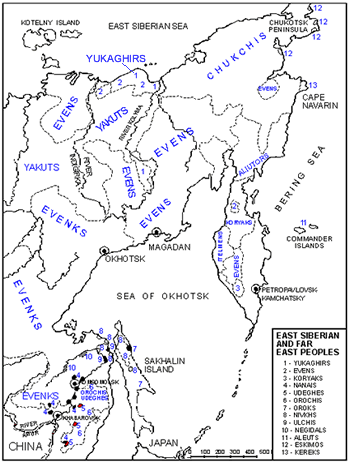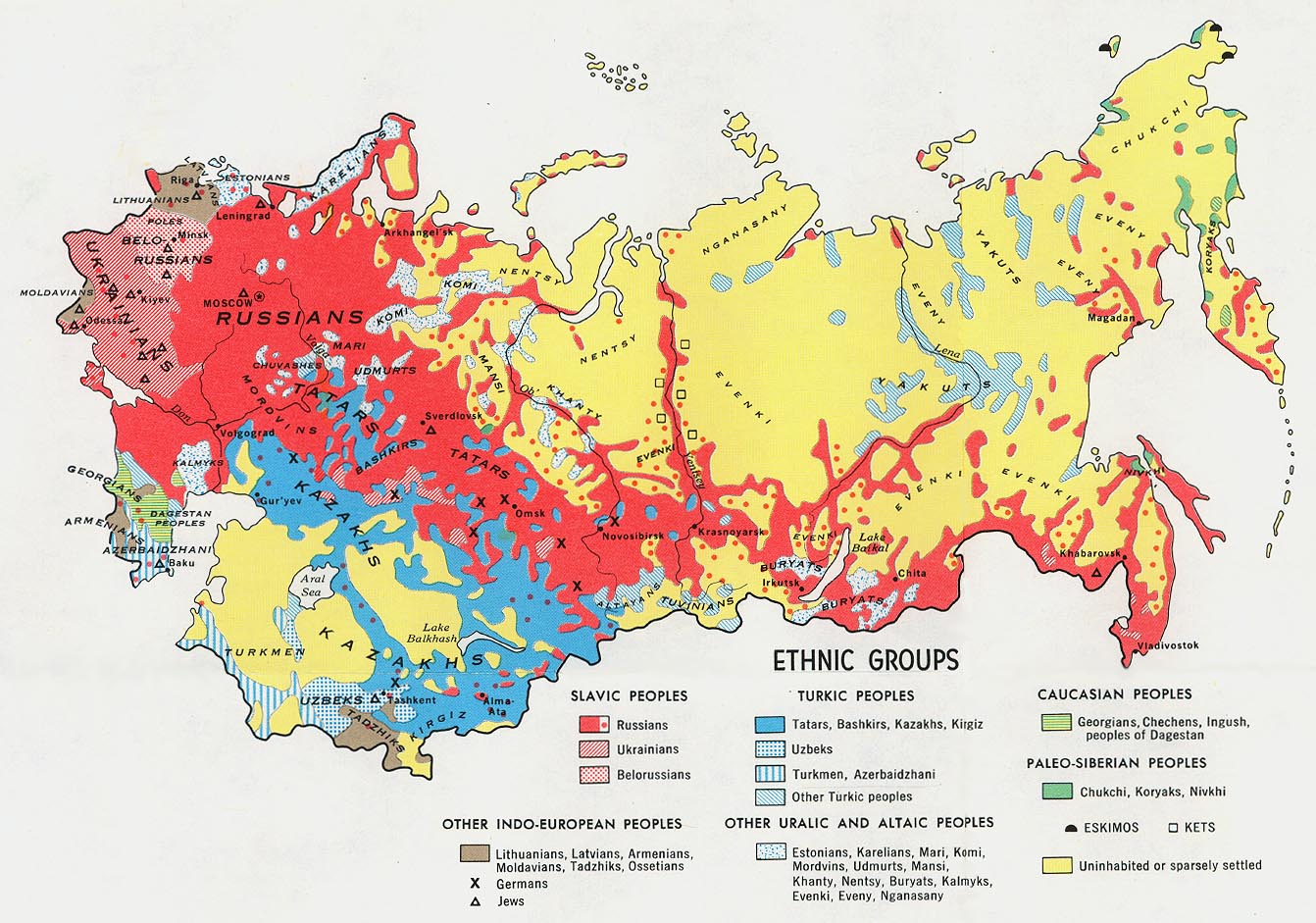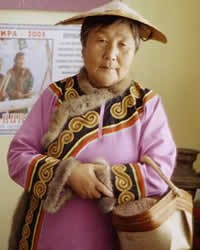

The Nivkhs (AKA, Gilyaks) are a small people group who inhabit regions of the Far East on the island of Sakhalin and basin of Lower Amur. The word " Gilyaks" in Tunguso-Manchu language means "people, moving with the help of twin oars on big boats." The word "Nivkhs" means "man." In 1989, according to the census, there were 4,673 people. A territorial sign divides the Gilyaks into two groups: Insular (Sakhalin) and mainland. The Sakhalin Nivkhs used to occupy the whole territory of the island; however, now it mainly only occupies its northern part. Mainland Nivkhs inhabit lower Amur, Amur estuary coast, and Tatar Strait. The Gilyak language can be distinguished within three dialects: Amur, East Sakhalin, and North Sakhalin.
The economy of Gilyaks was complex and basically was of a hunting nature. The types of trade that were defined by the environment were fishing, sea hunt trade, and hunting. Products of hunting and sea hunt trade were an essential help in their economy. The hunting trade was very important to their economy; it was even on the same level of importance as fishing. The hunting trade provided them with fat, meat, provender for dogs, skins for clothes and footwear, leather and so on. At the same time, Gilyaks were also involved in livestock production. Dog production was an old branch of the Gilyak's economy. The dogs were used as transportation when hunting and as sacrifices. These occupations formed the material base of their lives. Fishing for salmon breeds is a complex occupation that had a paramount economic importance. Gilyak fishermen have studied all the water basins of their regions and fish resources of those, as well as the peculiarities of migration of salmon fish, because of their century's practical experience. Once fishermen become experienced, they reach this certain degree of perfection. By the rivers' stream and meteorological conditions, the Gilyak define along which riverside there will be more fish. Based on their suspicions, they build their fishing camps accordingly. Their vegetable products in their food rotation included: berries, nuts, herbs, algae and shellfish. Gilyaks lived in tribes, and the tribe was the main self-governing cell. The supreme authority of the Gilyak's government was the Council of Elders. In the process of a long historical development, they were able to create their own graphic art, presenting rather high artistic values. Until the middle of the 19th century, the Gilyaks remained outside of the influence of any state authorities. In the community of the Gilyaks, there are a lot of folklore, songs, and myths on how the universe (including humans) was created. There were also some on how ancient fantastic heroes, spirits and beast had battled with each other.
One of the most distinctive aspects of the Gilyak lifestyle is their enduring dependence on the natural environment, especially the rivers and coastal waters. Salmon fishing remains central not only to their diet but also to their cultural identity, and traditional knowledge related to fishing, seasonal cycles, and the behavior of animals continues to be passed down within families. Even as modernization has introduced new forms of employment and housing, many retain a way of life that is closely tied to the rhythms of nature, demonstrating a continuity with their historical patterns of living along waterways and coastal regions.
Another unique feature of their present lifestyle is the tension between cultural preservation and assimilation. Most Gilyaks now speak Russian as their primary language, and many aspects of their daily life resemble those of the broader Russian population. At the same time, there is a strong awareness of their distinct identity, and efforts are being made to preserve traditional language, customs, and knowledge. This creates a lifestyle in which modern influences coexist with older traditions, often within the same household or community.
Cultural ceremonies and seasonal observances provide opportunities to preserve and express this heritage, even as the people adapt to contemporary conditions.
Recreation and entertainment among the Gilyaks are closely connected to their cultural traditions and communal life. Music and song play an important role, often featuring vocal performances, rhythmic patterns, and the use of simple instruments such as drums. These musical expressions are frequently tied to storytelling, seasonal activities, and traditional beliefs, rather than existing as purely secular entertainment. Dance and performance are also part of community events, especially during festivals or cultural gatherings where traditional clothing and rituals may be displayed.
In addition, communal festivals remain an important source of social enjoyment and cultural continuity. One of the most well-known is the traditional bear festival, which involves feasting, music, storytelling, and ritual acts that reflect the Gilyak's understanding of the relationship between humans and the natural world. Such gatherings provide not only entertainment but also a means of strengthening community bonds and passing on cultural values to younger generations.
At a more everyday level, recreation among the Gilyaks often includes time spent with family and community members, sharing meals, telling stories, and participating in seasonal activities such as fishing and food preparation. These activities, while practical in nature, also serve social and cultural purposes, reinforcing relationships and identity within the group.
Gilyaks are primarily shamanist. The traditional religion was partially based on animist beliefs before the Russians encouraged them to convert to Eastern Orthodox Christianity. They believed that the island of Sakhalin is a giant beast lying on its belly and the hair was the trees of the island. The Gilyaks thought that the Earthquakes meant that the beast was upset, therefore it awoke and trembled. They have a variety of gods the rule over the mountains, rivers, seas, and sky. Today, some of the Gilyaks have transformed their religion to Russian Orthodoxy or other religions; however, there are still many that practice the traditional beliefs. Fire is the symbol of the unity of a clan. It is thought to be a deity of their ancestors, who is protecting them from evil spirits and guarded them from harm. Gilyaks would 'feed' the deities by offering items to them. For example, the sea god would be feed something important so that he would protect the travelers.
Gilyaks need to find their acceptance in the King of kings rather than other people.
Pray for the Gilyak hearts to be hungry for Truth and to be searching for the One True Living God.
Pray for messengers to go to the Gilyak and to present the gospel not only with words which can be understood but with their very lives.
Pray for Gilyak believers to grow in their faith and to carry the good news to other groups living around them and even those far away.
Scripture Prayers for the Gilyak, Nivkh in Russia.
Nivkhs, http://en.wikipedia.org/wiki/Nivkhs#Religion
"The Nivkhs", http://russia.rin.ru/guides_e/4715.html
| Profile Source: Joshua Project |