


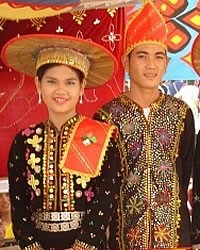

Upper Kinabatangan in Malaysia are an indigenous people of eastern Sabah, especially in the upper reaches of the Kinabatangan River in Tongod District, with some presence in Lahad Datu District. The editor-provided comma rule applies here, so this profile correctly uses Upper Kinabatangan in Malaysia throughout. The strongest location evidence places them specifically in Tongod District, primarily along the upper Kinabatangan River, and reliable outside linguistic sources confirm that Upper Kinabatangan is a recognized Austronesian language of Sabah rather than merely a geographic label.
They are best understood within the wider Paitanic / Orang Sungai world of eastern Sabah. A reliable scholarly overview of Sabah's cultural diversity specifically identifies the Upper Kinabatangan peoples as one of the Paitanic-speaking peoples often grouped under the broader Orang Sungai ("river people") identity. That same source notes that related peoples such as the Ida'an, Begak, and Subpan are historically connected to Upper Kinabatangan ancestry, which strongly suggests that Upper Kinabatangan in Malaysia are not a random micro-group but part of an older eastern Sabah riverine ethnolinguistic network.
Their language is Upper Kinabatangan, also called Kalabuan in some sources. Reliable outside linguistic references identify it as an Austronesian language of Sabah within the Paitanic branch, and one language-family source groups it with Lanas Lobu and Tampias Lobu under the Upper Kinabatangan subgroup. Another source notes that the broader Kinabatangan language complex is associated with the ethnonym Lobu, which helps explain why outside references sometimes use overlapping names. In practical terms, many likely use their language in home and local community settings while also using Sabah Malay / Standard Malay in school, government, and wider public life.
Upper Kinabatangan in Malaysia live in the interior river world of eastern Sabah, especially in the upper Kinabatangan basin around Tongod, rather than in the lower floodplain tourist zones more commonly known to outsiders. This is a landscape of river corridors, forested uplands, interior settlements, and rural communities where movement has historically followed waterways more than major roads. The internal location listing places them in Tongod District and also in Lahad Datu District, which fits a people whose life is tied to the eastern Sabah interior rather than one single town.
A strong outside academic source on Sabah states that the Upper Kinabatangan peoples are among the Paitanic-speaking Orang Sungai, literally "river people," distributed along the eastern rivers of Sabah. That is especially useful because it gives a reliable cultural frame: they are best understood as a river-oriented people whose identity is shaped by inland river settlement, kinship ties, and local language continuity. In communities like these, daily life has historically been shaped by village agriculture, river travel, fishing, forest-edge resources, and close family networks, even though modern roads, schooling, and wage labor now affect many households as well.
Upper Kinabatangan in Malaysia are identified primarily with Christianity, but this must be handled carefully. The internal source clearly lists Christianity as their largest religion, while also showing that Islam and ethnic religion remain present in meaningful ways. That means they should not be treated as a people with no Christian witness, but neither should outward Christian identity be assumed to mean deep biblical discipleship across the whole people. This is exactly the kind of setting where some may truly know Jesus Christ, while others may carry Christian identity more by family history, village custom, or church association than by clear repentance and strong grounding in Scripture.
Because both Islam and ethnic religion are still present, spiritual life among Upper Kinabatangan in Malaysia may be mixed in different households or local communities. Some may live under a Christian label while still feeling pressure from older spiritual fears, inherited ritual assumptions, or family expectations shaped by non-biblical religion. Others may live in mixed-faith family settings, which is not unusual in Sabah. A recent scholarly piece on Sabah's interfaith life notes that interfaith marriages and mixed-faith families are longstanding and widespread in the state. That broader Sabahan reality matters here because it can make spiritual identity more complex and can blur the line between outward religious affiliation and genuine biblical faith. Scripture portions are available in their language.
Upper Kinabatangan in Malaysia need strong biblical discipleship in a setting where Christian identity is present but spiritual depth should not be assumed. When a people group has a visible Christian presence while also retaining meaningful Islamic and traditional religious influence, the danger is often not open rejection of religion but mixed belief, shallow Christianity, and confusion between church familiarity and true new birth in Christ. They need pastors, teachers, and mature believers who will preach repentance, the gospel, and the authority of Scripture clearly rather than if Christian background equals spiritual maturity.
They also need discipleship that is patient and relational because of Sabah's social reality. In a region where mixed-faith families and interfaith relationships are common, following Christ may not always mean open hostility, but it can mean blurred convictions, compromise, or quiet pressure to keep peace at the expense of truth. Believers need careful teaching so they can love family members sincerely while standing firmly on the exclusivity of Jesus Christ and the authority of God's Word. The goal is not merely peaceful coexistence, but genuine conversion and faithful discipleship.
Their interior river setting also matters. Communities in Tongod and the upper Kinabatangan region can face uneven access to transportation, medical care, education, and regular connection to mature biblical teaching, especially compared with more connected parts of Sabah. Smaller inland communities are easy to overlook, and when villages are spread across river and upland zones, consistent pastoral care and leadership training can be harder to sustain. They need strong local believers, Scripture-centered homes, and durable fellowships that can remain faithful over time rather than drifting into nominal religion or spiritual compromise.
Pray that Upper Kinabatangan in Malaysia would grow beyond nominal or inherited Christianity into deep repentance, strong faith, and joyful obedience to Jesus Christ.
Pray that where Christian identity is mixed with Islamic influence, older spiritual fears, or cultural religion, the Lord would bring biblical clarity, conviction of sin, and lasting transformation.
Pray for pastors, evangelists, and church leaders among Upper Kinabatangan in Malaysia to handle Scripture faithfully, teach sound doctrine clearly, and shepherd people with humility and courage.
Pray that families in Tongod and the upper Kinabatangan communities would become places of prayer, Scripture, repentance, and faithful discipleship.
Pray that believers in mixed-faith family settings would stand firmly on the truth of the gospel while showing wisdom, love, and Christlike courage.
Pray for practical help where needed in areas such as transportation, medical access, education, and regular connection to mature biblical teaching in interior river communities.
Scripture Prayers for the Kinabatangan, Upper in Malaysia.
https://www.ethnologue.com/language/dmg/
https://www.ethnologue.com/subgroup/1831/
https://en.wikipedia.org/wiki/Kinabatangan_language
https://www.scribd.com/document/515556116/B182-12
https://www.iseas.edu.sg/articles-commentaries/iseas-perspective/2024-73-understanding-sabahs-exemplary-interfaith-relations-from-a-grassroots-perspective-by-suraya-sintang/
| Profile Source: Joshua Project |


