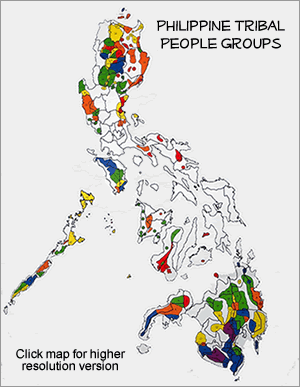
The Kinabalian are a small but distinct people group living on the southeastern tip of Leyte Island in the Eastern Visayas region of the Philippines. Their name comes from Kinabalianon, the language they speak, and is tied to their ancestral hometown of Cabalian — now officially known as San Juan — in the province of Southern Leyte. The word Kabalian itself is believed to derive from the Cebuano phrase meaning "the place where the straight coastline breaks into a curve," a fitting description of the geography their forebears chose as home. Today Kinabalian speakers are concentrated in just six barangays (villages) in the eastern portion of San Juan municipality.
Long before Spanish colonizers arrived, the people of Cabalian were seafarers. Their ancestors regularly sailed to Surigao and Butuan on the island of Mindanao to trade for gold, a fact recorded by the Augustinian friar Agustín María de Castro. This seafaring heritage shaped the Kinabalian language itself, which bears the influence of Surigaonon, Boholano, and Cebuano — though it remains distinct from all of them and is not mutually intelligible with any neighboring tongue. The mountains of southern Leyte shielded the Cabalian coast from the northward spread of Waray-Waray, allowing the Kinabalian to develop as a linguistically unique community. Spanish colonization brought Catholicism, and the municipality's patron saint, John the Baptist, became a central figure in communal and spiritual life.
Fishing and subsistence farming form the backbone of Kinabalian livelihoods. The sea has always defined this people, and many families depend on the surrounding waters of the Pacific coast and Cabalian Bay for their daily catch. Rice cultivation, coconut farming, and small-scale trade supplement household incomes in what remains a largely rural and agricultural economy. Southern Leyte is also known for abaca fiber production, and some Kinabalian households engage in weaving and other cottage industries.
Family life is deeply communal. Extended families tend to live and work closely together, with elders commanding respect and playing important roles in decision-making. Children are raised within strong family networks, and hospitality toward neighbors and visitors is a cherished cultural value. Filipino bayanihan — the spirit of communal unity — is alive in Kinabalian villages, where neighbors readily help one another in times of need.
The most anticipated celebration of the year is the feast of San Juan Bautista (St. John the Baptist) on June 24. Leading up to the feast, a nine-day novena called jornadas begins on June 15, during which the patron saints of all eighteen barangays are processioned to small outdoor chapels near the baroque parish church. On the feast day itself, statues are carried through the streets in grand procession. Music, dancing, and communal feasting mark the occasion, weaving together Catholic devotion and a deep sense of local identity that the Kinabalian call their own.
Christianity is the primary religion of the Kinabalian, and the Catholic faith brought by Spanish missionaries in the colonial era remains deeply embedded in community life. Church attendance, the veneration of saints, religious festivals, and the sacraments are all central to the way many Kinabalian understand and practice their faith. For most, being Catholic is inseparable from being Kinabalian — it is part of their identity as a people.
At the same time, a significant portion of the community continues to hold traditional ethnic religious beliefs alongside or beneath their Christian identity. Practices rooted in animism and folk religion — including reverence for spirits connected to the land and sea — persist in varying degrees. This blend of Catholic practice and indigenous belief is common across rural Philippine communities and reflects a faith that, for many, has not yet been fully transformed by the gospel.
A modest but meaningful Evangelical presence does exist among the Kinabalian. Believers who have encountered Christ personally through biblical faith represent a real, if small, portion of the population. These men and women carry a great privilege and responsibility: to be witnesses of the living gospel to their own community, and potentially to serve as missionaries to the many unreached and less-reached peoples throughout the Philippines and beyond.
The Kinabalian face significant physical vulnerabilities. Southern Leyte is prone to typhoons, flooding, and landslides — the catastrophic 2006 mudslide in nearby Guinsaugon serves as a painful reminder of how quickly natural disaster can strike. Poverty limits access to quality healthcare and education, and many young people leave their villages in search of economic opportunity elsewhere, placing pressure on the continuation of Kinabalian culture and language. A Bible translation in the Kinabalian language has been started but is not yet complete, meaning that most of the community does not yet have access to Scripture in the language they understand best.
Spiritually, the greatest need is for the gospel to take deep root. Much of the Kinabalian community practices a form of Christianity that mingles Catholic tradition, folk religion, and animistic belief. What is needed is not simply more religion, but a personal encounter with Jesus Christ that transforms hearts, families, and communities from the inside out. Discipleship, biblical teaching, and trained local leaders are essential to seeing the church among the Kinabalian grow in depth and health.
Pray that the Bible translation underway in the Kinabalian language will be completed and widely distributed so that people can hear God's word in their heart language.
Pray that Kinabalian believers will grow in vibrant, biblically grounded faith and become a gospel force reaching the less-reached peoples of the Philippines.
Pray for protection from natural disasters and for resilient, thriving communities in the villages of San Juan.
Pray that the Holy Spirit will draw Kinabalian people into a living, saving relationship with Jesus Christ.
Scripture Prayers for the Kalinga, Tanudan in Philippines.
Wikipedia – Kabalian language
Wikipedia – San Juan, Southern Leyte
Southern Leyte Provincial Government – San Juan History
Ethnologue – Kinabalian (cbw)
Omniglot – Kinabalian language
| Profile Source: Joshua Project |