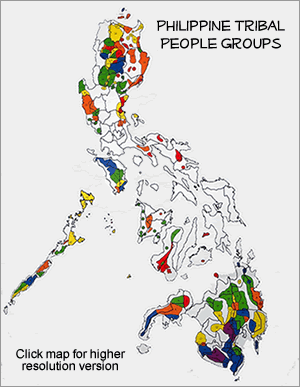
The Rajah Kabungsuan Manobo are an Indigenous people located in Mindanao, especially along the northern border of Davao Oriental, the southeastern edge of Agusan del Sur, and the southern part of Surigao del Sur, including the area of Lingig and Rajah Kabungsuan. They belong to the wider Manobo cultural family, among whom the term Manobo generally means "people" and reflects deep ancestral ties across Mindanao's interior regions.
Their current language is Manobo, Rajah Kabunsuwan, an Austronesian language with distinct dialectal variation preserved through relative geographic isolation. Some villages remain accessible mainly through rugged trails or motorcycle paths, which has contributed to maintaining long-held traditions and community structures.
Their heritage connects to early proto-Austronesian settlers who spread across Mindanao's river valleys, hillsides, and forested interiors thousands of years ago. Through generations, the Rajah Kabungsuan communities have retained their identity despite pressures from migration, modernization, and external influences.
Rajah Kabungsuan Manobo households organize themselves in small settlements near streams, forest clearings, or hillsides, often consisting of a modest cluster of homes. Their daily work centers on subsistence farming, complemented by hunting, fishing, and forest gathering—practices common among many Manobo groups across Mindanao.
Family and community life follow customary leadership under a datu, whose authority reflects respect, mediation, and responsibility for maintaining order and tradition. Hospitality remains a notable trait, and visitors are typically welcomed warmly according to long-standing custom.
Cultural celebrations may involve oral storytelling, dance, and traditional attire that reinforce identity and pass down values across generations. Seasonal rhythms, including planting and harvest patterns, shape family routines and communal gatherings.
Their primary religious orientation is an ethnic religion marked by traditional spiritual practices connected to land, ancestors, and unseen powers. While these beliefs remain influential, some Rajah Kabungsuan Manobo have become followers of Christ, and churches with evangelical faith and practice are present among them.
From a Christian standpoint, Jesus Christ alone offers salvation, truth, and freedom, and He desires to bless every people group, including the Rajah Kabungsuan Manobo, with his transforming grace.
Remote locations limit access to education, adequate healthcare, and economic opportunities. Travel between communities is difficult, especially where the terrain requires motorcycle trails or footpaths.
Ongoing challenges include environmental pressures such as diminishing forest resources and limited agricultural productivity. Many families face instability due to land issues and changing economic conditions across Mindanao.
Reliable livelihood options, sustainable land management, and improved infrastructure remain significant factors affecting daily life and community well-being.
Pray for physical provision—better access to education, healthcare, and sustainable livelihoods.
Pray for wisdom for community leaders as they guide families amid environmental and social pressures.
Pray for deep spiritual growth among believers and for God's word to guide their choices and relationships.
Because a gospel presence exists among them, pray that the Rajah Kabungsuan Manobo churches will become a strong missionary force to less-reached peoples in Mindanao.
Scripture Prayers for the Manobo, Rajah Kabungsuan in Philippines.
https://www.wycliffephilippines.org/projects-rajahkabungsuan
https://www.yodisphere.com/2022/05/Manobo-Tribe-History-Culture-Traditions.html
http://olac.ldc.upenn.edu/language/mqk
https://www.peoplegroups.org/people_groups/PG007759/
https://tribumanuvu.blogspot.com/2025/03/manobo-tribe.html
| Profile Source: Joshua Project |