


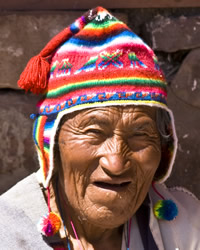

The Southern Aymara are an Indigenous people group living primarily in the southern highlands of Peru, especially in the region of Puno near Lake Titicaca. They are part of the larger Aymara ethnolinguistic family that also spans Bolivia and northern Chile. Historically, the Aymara were established agricultural and pastoral communities long before the rise of the Inca Empire and were later incorporated into the Inca political system before Spanish colonization in the 16th century.
Under Spanish colonial rule, Aymara communities experienced forced labor systems, tribute demands, and strong Catholic missionary influence. Despite these pressures, they preserved much of their language, social organization, and worldview. The Aymara language remains widely spoken in southern Peru and has official recognition, reflecting the resilience of their cultural identity.
Today, Southern Aymara communities continue to maintain traditional forms of dress, agricultural practices, and communal structures rooted in ancestral heritage. Their history is marked by endurance through political marginalization, economic hardship, and cultural pressure, yet their identity remains strong and distinct within Peruvian society.
Most Southern Aymara live in rural, high-altitude communities where agriculture and livestock herding are central to daily life. Potatoes, quinoa, barley, and alpaca or sheep herding form the backbone of the local economy. Life in the Andean highlands can be physically demanding due to altitude and climate, and economic opportunities are often limited compared to urban areas.
Access to education and healthcare has improved in recent decades, yet disparities remain. Many communities face challenges such as poverty, limited infrastructure, and seasonal migration as younger generations move to cities seeking work. Nevertheless, strong communal bonds and extended family networks provide social stability and mutual support.
Culturally, music, dance, woven textiles, and traditional celebrations remain vibrant. Indigenous dress—particularly among women—continues to be worn daily in many villages. While modernization influences younger generations, many Southern Aymara maintain pride in their language and cultural identity.
What Are Their Beliefs--
Traditionally, Aymara spirituality centers on a worldview that integrates the natural and spiritual realms. Reverence for Pachamama (Mother Earth) and respect for ancestral spirits have historically shaped rituals connected to agriculture, health, and community well-being. These beliefs emphasize harmony between humans, nature, and the unseen world.
Since Spanish colonization, the Roman Catholic Church has had a strong presence among the Southern Aymara. Today, many identify as Catholic, though traditional beliefs often coexist alongside Christian practices in syncretistic forms. Festivals and religious observances may blend biblical themes with pre-Christian elements.
Evangelical and Protestant churches have grown in parts of the region in recent decades.
A significant portion of Aymara people identify as Christian, yet levels of evangelical discipleship vary. There remains a need for deeper biblical understanding and contextualized teaching that clearly communicates the gospel within Aymara culture.
Southern Aymara communities often face high levels of rural poverty. Limited employment diversity, dependence on small-scale agriculture, and vulnerability to climate conditions affect long-term stability. Sustainable agricultural development, fair market access, and educational opportunities could greatly strengthen economic resilience.
Improved access to healthcare, bilingual education (Aymara and Spanish), and infrastructure development remain important. Preserving language while providing pathways for young people to pursue higher education or vocational training can help balance cultural continuity with economic opportunity.
Although Christianity is present, there is ongoing need for mature Indigenous Christian leadership rooted in Scripture and sensitive to cultural context. Evangelical ministries often focus on leadership training, Bible teaching in the Aymara language, and empowering local believers to disciple others within their own communities and neighboring groups.
Pray for deeper understanding of the gospel among Southern Aymara believers, that faith would be rooted firmly in scripture rather than blended with traditional spiritual practices.
Pray for strong Aymara Christian leaders to be raised up—pastors, teachers, disciplers, and evangelists.
Pray for Bible teaching and discipleship resources in the Aymara language to continue strengthening local churches.
Pray that Southern Aymara believers would become Christian workers who carry the hope of Christ to other indigenous communities who have limited gospel access.
Scripture Prayers for the Aymara, Southern in Peru.
https://en.wikipedia.org/wiki/Aymara_people
https://www.ethnologue.com/language/aym
https://minorityrights.org/country/peru/
| Profile Source: Joshua Project |


