


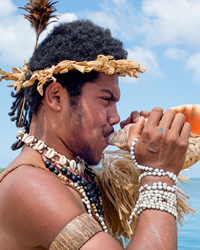

Among the many communities that make up New Caledonia's richly layered population, the Wallisian people occupy a distinctive place — Polynesian in language and culture, transplanted by circumstance, and deeply connected to a homeland more than two thousand kilometers away. The Wallisians trace their origins to Uvea, the main island of the Wallis and Futuna archipelago in the west-central Pacific. Their language, known as Wallisian or Faka'uvea, belongs to the Western Polynesian branch of the Austronesian family and bears close kinship to Tongan, a reflection of the Tongan maritime empire's powerful presence in the region during the fifteenth century. The Wallisian people see themselves as distinct from the Futunans — their neighbors and fellow migrants — even though the two communities are often grouped together by outsiders.
Wallisians began arriving in New Caledonia in significant numbers during the 1950s, drawn by labor opportunities in the nickel mining industry that was expanding rapidly across the main island at the time. The nickel boom of the 1970s accelerated this migration, and over the decades the Wallisian community in New Caledonia has grown to exceed the population still living on Wallis Island itself. Most Wallisians in New Caledonia today reside in and around Nouméa, particularly in the South Province, where they form one of the more visible Polynesian communities in an already ethnically diverse territory.
The islands of Wallis and Futuna came under French influence through a combination of Catholic missionary activity and political alliance. When Marist missionaries arrived in 1837, they found a society organized under traditional Polynesian kingdoms. By 1842, the people of Wallis had embraced Catholicism, and the queen of Uvea subsequently asked France for formal protection in 1887. The islands were administered under New Caledonia for decades before eventually becoming a separate French overseas collectivity. This layered history — Polynesian kingdoms, Marist missionaries, French colonial administration, and labor migration — shapes the identity of every Wallisian living in New Caledonia today.
The Wallisian community in New Caledonia is concentrated in the greater Nouméa area, and many Wallisians work in the territory's mining industry — a sector that first drew their grandparents and great-grandparents across the Pacific. Others are employed in construction, domestic work, and the service sector. Unemployment, however, has been a persistent challenge. Despite living in one of the wealthier territories in the Pacific, Wallisians often face difficulty securing stable employment and experience higher unemployment rates than some other communities. Many families live in modest circumstances in suburban neighborhoods around the capital.
At the heart of Wallisian social life is the extended family. Decisions about marriage, land, and major life events are shaped by family networks and the expectations of community elders. On the home islands, land is held communally by kin groups under customary law, and this deep sense of collective responsibility carries over into the diaspora community in New Caledonia. Children are raised in households where elders are honored, and the values of generosity and reciprocity are instilled early. Wallisian culture places high importance on customary gifts — the sharing of food, tapa cloth, woven mats, and other goods — as expressions of respect and social obligation at weddings, funerals, and major religious milestones.
The traditional diet of the Wallisian people centers on root vegetables such as taro, yams, sweet potatoes, and cassava, along with breadfruit, pork, chicken, coconut, and fresh fish. Food preparation in a traditional underground oven — the umu — remains a cherished practice for celebrations and community gatherings. In New Caledonia, the annual Wallis and Futuna Festival held in Nouméa brings Wallisian and Futunan communities together for dancing, singing, traditional crafts, and communal feasting. These occasions are important anchors of cultural identity in a migration context, allowing families to pass traditional songs, dances, and customs to younger generations born far from Uvea. The Kailao — a striking warrior dance originally from Uvea — is one of the most recognized cultural expressions of the Wallisian people and is performed at festivals across the Pacific.
Roman Catholicism is the defining religious identity of the Wallisian people, both on the home islands and in New Caledonia. The Catholic faith was introduced by Marist missionaries in the 1830s and 1840s and took root with remarkable speed. It became so thoroughly woven into Wallisian life that Catholic sacraments — baptism, first communion, confirmation, and marriage — structure the major passages of life from birth to death. On important feast days, Mass is celebrated and is followed by the kava ceremony and the katoaga, a communal exchange of gifts in which traditional items are shared across family and village networks. The Catholic Church has long influenced not only worship but also education, governance, and social norms among Wallisian communities wherever they live.
Yet alongside this deeply embedded Catholic practice, traditional Polynesian spiritual sensibilities have not entirely disappeared. The people of Wallis carry a rich heritage of Polynesian cosmology — a world in which the gods, the ancestors, and the living remain in relationship with one another. The Wallisian legend of Tagaloa, the god who first established Wallisian culture and whose net cast into the sea became an island, reflects an older understanding of the world as saturated with spiritual meaning and divine agency. Traditional medicines practiced mostly by women — using local plants, massage, and other remedies — are understood not merely as physical treatments but as part of a broader trust in healing forces that work alongside or beyond the visible world. On the home islands, many people still consult traditional healers before seeking hospital care, trusting in remedies that draw on both plant knowledge and a wider spiritual framework.
The kava ceremony itself, while now practiced in a social and ceremonial context, carries deep roots in Polynesian ritual life — including the honoring of chiefs and the ordering of relationships between people, gods, and the community. Wallisian oral tradition holds that the first kava plant grew from the grave of a child, a story that points to the sacred weight these practices carry in the Wallisian imagination.
Only in Jesus Christ, who conquered death and offers living water that never runs dry, can the deepest longings of the Wallisian heart find true fulfillment.
Wallisians in New Caledonia face real economic pressures, including elevated unemployment and the social difficulties that come with being a minority community navigating a complex multi-ethnic society. Many younger Wallisians are caught between two worlds — connected to Polynesian custom and family obligation but also shaped by French education and the urban environment of Nouméa. Young people who grow up without strong roots in their language and traditions face particular challenges of identity and belonging. Access to education beyond secondary school often requires leaving the territory entirely, and upward economic mobility has been difficult for many Wallisian families.
Spiritually, while the Catholic faith is widespread and genuinely held, many Wallisians have yet to encounter a personal, saving relationship with Jesus Christ that goes beyond religious ritual and cultural identity. The blending of Catholic observance with older Polynesian spiritual practices — a trust in the power of ancestors, traditional healers, and sacred ceremonies — points to spiritual needs that Catholic structures alone have not fully addressed. Wallisian believers need discipleship that grounds them in God's Word and helps them navigate the relationship between their Polynesian heritage and a living faith in Christ. Where the gospel has taken root among Wallisians in New Caledonia, those believers have a remarkable opportunity to reach not only their own community but also the Kanak, European, and other ethnic communities they live alongside every day.
Pray that Wallisian believers in New Caledonia would grow in a genuine, personal faith rooted in scripture and would share the gospel boldly with neighbors from Kanak, European, and other communities.
Ask God to raise up pastors and teachers who can disciple Wallisian families in New Caledonia in a way that speaks honestly to the spiritual questions their Polynesian heritage raises.
Pray for economic opportunity, stable employment, and social flourishing for Wallisian families who have often struggled to find their footing in New Caledonia's unequal economy.
Ask the Lord to draw Wallisian young people — caught between cultural worlds — into a deep and lasting identity rooted in Christ rather than in circumstance or ethnicity.
Scripture Prayers for the Wallisian, East Uvean in New Caledonia.
| Profile Source: Joshua Project |



