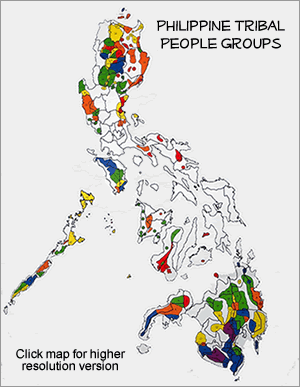
The Eastern Tawbuid are an indigenous Mangyan people of Mindoro in the Philippines, especially in the central and eastern parts of Oriental Mindoro. They belong to the wider Tawbuid Mangyan world but are distinguished here by the eastern branch of the language. Their language is Eastern Tawbuid, an Austronesian language of the South Mangyan cluster spoken in municipalities such as Socorro, Pinamalayan, and Gloria. That places them among the long-rooted upland peoples of Mindoro whose identity is tied to the island's interior rather than to the more settled lowland coast.
Publicly available historical detail focused narrowly on the Eastern Tawbuid themselves is limited, so it is better to describe them carefully than to pretend to know more than the evidence supports. What is clear is that they are part of the larger Mangyan mosaic of Mindoro, where each people group maintains its own language, customs, and community identity within the island's rugged interior.
The Eastern Tawbuid are best understood as an upland Mangyan people whose daily life is shaped by the interior of Mindoro rather than by urban or coastal life. Communities in central and eastern Mindoro are often more isolated than the lowland towns, so family ties, village relationships, and practical self-reliance tend to matter greatly. In settings like this, extended family usually plays a large role in household life, work, marriage, and mutual support. Because highly detailed public ethnographic material on the Eastern Tawbuid themselves is not abundant in easily accessible sources, it is wisest to stay careful and not overstate narrow local customs.
Their livelihood is most plausibly tied to the broader Mangyan pattern of upland farming, forest use, and small-scale exchange. Across Mindoro, indigenous interior communities commonly rely on root crops, rice or corn where possible, bananas, gathered forest resources, and locally available food sources, while contact with lowland markets varies by distance and access. Meals in such communities are often simple and practical, shaped by what can be grown, gathered, or traded nearby. Recreation and social life are usually communal rather than commercial—family gatherings, storytelling, singing, local ceremonies, and community events carry more weight than modern entertainment. Their language remains an important marker of identity, though many Mangyan communities also use Tagalog in wider contact with lowland society.
The Eastern Tawbuid are mostly identified with ethnic religion, though there is also a Christian presence among them. That means they should not be treated as completely unreached in the narrowest sense, but the dominant spiritual outlook is still not biblical Christianity. Where ethnic religion remains primary, people often look to the spirit world, inherited rituals, and traditional spiritual practices for protection, healing, or guidance rather than resting fully in Jesus Christ alone.
Because there is also some Christian witness among them, some may identify with Christianity while still carrying older spiritual loyalties. If Christ is named while fear of spirits, ritual dependence, or trust in inherited religious systems remains central, then the gospel has not yet taken root in biblical clarity. Scripture resources are reported as available in their language.
The Eastern Tawbuid need a clear and faithful gospel witness that calls them to turn from every competing spiritual loyalty and trust Christ alone. Since ethnic religion still appears to shape much of their worldview, they need more than occasional exposure to Christian ideas. They need genuine conversion, strong discipleship, and local believers who will stand firm without compromise.
They also likely face practical needs common to upland indigenous communities in Mindoro. Better access to medical care, stronger schooling, clean water, and dependable transportation can make a major difference when communities are located in harder-to-reach interior areas. In remote settings, even ordinary illness, injury, or educational needs can become much heavier burdens. Practical help matters, but it should support the greater need for a durable, biblically grounded Christian witness.
Pray that the Eastern Tawbuid would turn from every spirit-centered religious practice and trust in Jesus Christ alone.
Pray that the Christian witness among them would be biblically clear, courageous, and free from compromise.
Pray for better access to medical care, education, clean water, and safe transportation in their communities.
Pray that the Lord would raise up faithful disciples among the Eastern Tawbuid who will stand firm in truth and make Christ known to others.
Scripture Prayers for the Tawbuid, Eastern in Philippines.
https://en.wikipedia.org/wiki/Tawbuid_language
https://en.wikipedia.org/wiki/Mangyan
https://en.wikipedia.org/wiki/Ethnic_groups_in_the_Philippines
https://en.wikipedia.org/wiki/Mindoro
| Profile Source: Joshua Project |