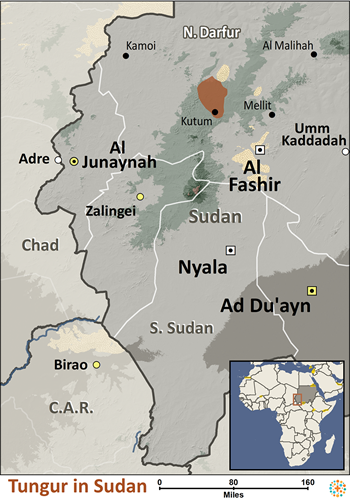

The Tungur, also known as the Tunjur, are an ethnic group found in western Sudan, particularly in the Darfur region. They are also present in neighboring Chad. Their origins remain a subject of scholarly debate. Some traditions claim Arab ancestry, while other historical and linguistic evidence suggests connections to earlier Nubian or indigenous populations of the region. During the medieval period, the Tungur played an important role in the history of Darfur and Wadai, establishing ruling dynasties that governed portions of present-day Sudan and Chad before being replaced by later kingdoms.
According to local traditions, the last Tungur ruler was driven out by his own people, after which the community gradually merged with neighboring groups, particularly the Fur. Over the centuries, many Tungur adopted the languages and customs of surrounding peoples. Their original language has largely disappeared, and today many speak Sudanese Arabic or languages of neighboring ethnic groups. Despite these changes, the Tungur have retained a distinct ethnic identity and continue to be recognized as a separate people.
The Tungur primarily live in rural areas where agriculture and livestock raising form the basis of daily life. Many families cultivate millet, sorghum, and other crops suited to the semi-arid environment of western Sudan. Others raise cattle, goats, sheep, and camels, often combining farming and pastoral activities to support their households. Life is shaped by seasonal rainfall patterns, and drought can have a significant impact on livelihoods.
They highly value family and clan relationships. Extended families often live near one another and provide mutual support during times of hardship. Community life revolves around farming cycles, family events, religious observances, and local markets. Traditional foods commonly include millet porridge, sorghum-based dishes, dairy products, and meat when available. Like many communities in Darfur, the Tungur have faced challenges related to conflict, displacement, and economic instability in recent decades.
The Tungur are predominantly Sunni Muslims. Islamic beliefs and practices shape their understanding of God, morality, family life, and community responsibilities. Daily prayers, fasting during Ramadan, observance of Islamic festivals, and participation in mosque life are important aspects of their religious identity. Most follow the Maliki tradition of Sunni Islam that is common throughout much of the Sahel region.
Although Islam is the dominant faith, some traditional beliefs and customs continue to influence community life. Folk practices concerning blessings, protection, healing, and spiritual forces may exist alongside formal Islamic observance. Religious identity is deeply woven into Tungur culture, and there is little known Christian presence among them. As a result, most Tungur have never heard a clear presentation of the biblical message that salvation comes through faith in Jesus Christ and His death and resurrection.
The Tungur need greater access to the gospel through trusted relationships, Scripture resources, and faithful Christian witnesses who can communicate biblical truth with wisdom and cultural sensitivity. The lack of an established Christian presence means that many have little opportunity to interact with believers or learn about Jesus from the Bible.
Practical needs are also significant. Many Tungur communities have been affected by the broader instability that has impacted Darfur and western Sudan. Challenges include economic uncertainty, access to healthcare, educational opportunities, reliable water sources, and long-term peace and security. Efforts that strengthen families, support agriculture and livestock production, and provide compassionate assistance can help meet tangible needs while opening doors for meaningful relationships.
Pray that the Tungur would have opportunities to hear a clear presentation of the gospel and understand the saving work of Jesus Christ.
Pray that God would bring peace and stability to the regions where the Tungur live and provide for their physical and spiritual needs.
Pray that the Tungur would be adopted through the People Group Adoption program so that churches and believers will commit to ongoing prayer, outreach, and future gospel engagement among them.
Pray that God would raise up faithful workers who will build genuine relationships among the Tungur and establish growing communities of believers who can reach future generations.
Scripture Prayers for the Tungur in Sudan.
https://en.wikipedia.org/wiki/Tunjur_people
https://en.wikipedia.org/wiki/Tunjur_kingdom
https://joshuaproject.net/people_groups/19159
https://www.britannica.com/place/Darfur
https://en.wikipedia.org/wiki/Darfur
| Profile Source: Joshua Project |