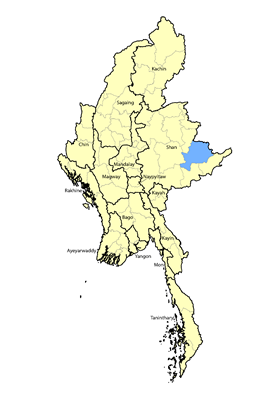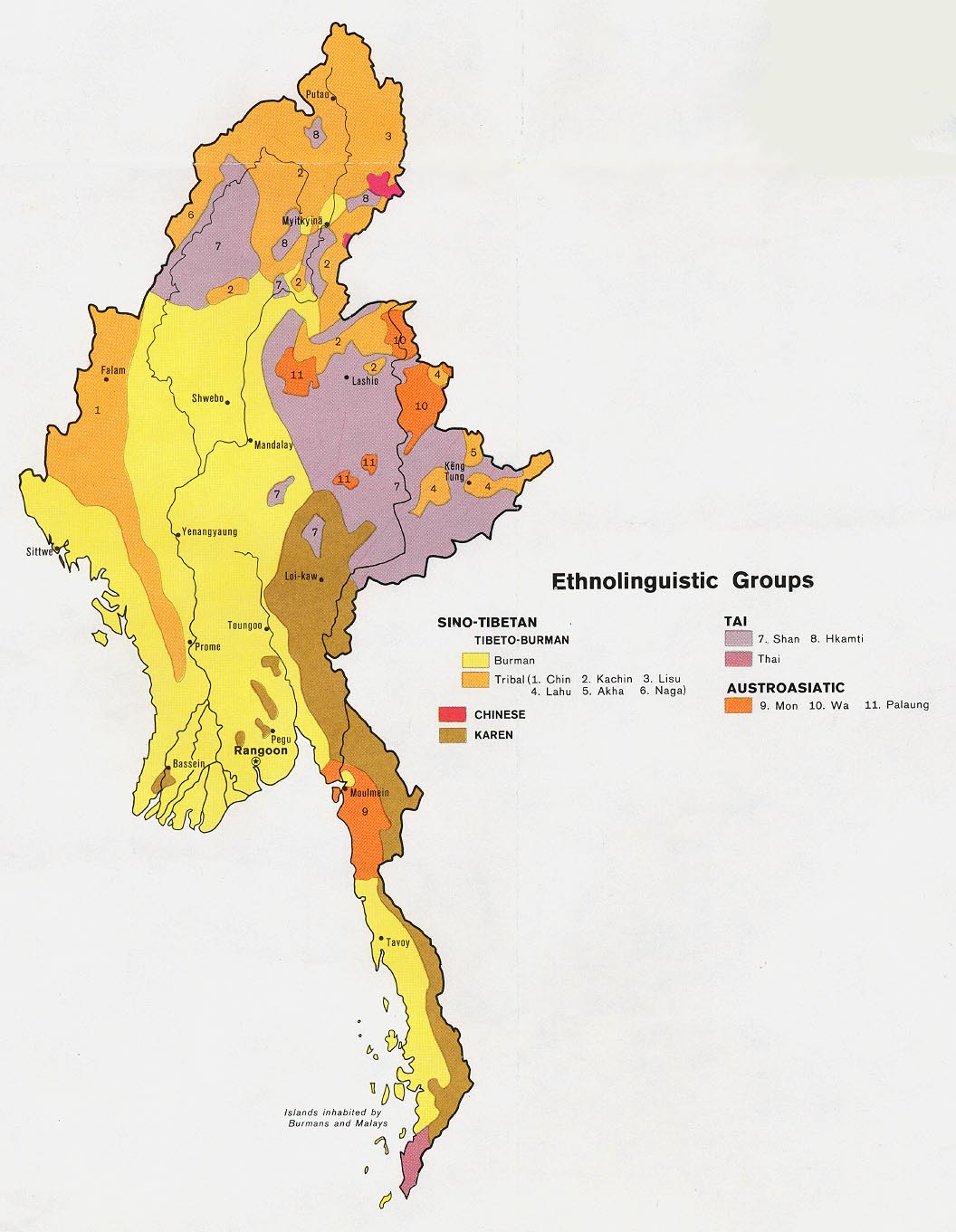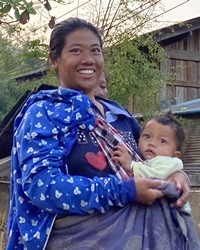

Mok people inhabit ten villages in three townships of eastern Shan State in northeast Myanmar. Their main area, which consists of rolling hills and forests, is just south of the ancient city of Kengtung. Other Mok communities are situated further north on the borders with China and Laos. Uniquely, sleepy Mong Khet Township has been "calculated to be the center of the?Valeriepieris circle, a figure drawn on the Earth's surface such that the majority of the human population lives within its interior." As many as 2,000 Mok speakers also live in the north Thailand provinces of Chiang Rai and Lampang.
Few people have ever heard of the Mok due to their identity being based on language. Despite their modest population, the Mok appear to consist of five divisions, each of which may constitute a distinct people group. Identifying the Mok is further hampered by the fact that other ethnicities in the area, including the Burmese, Lahu, and Akha, know the Mok by different names. Some call them Doi or Loi, which simply means "mountain" or "hill" people. Nearly all available information on this group comes from linguistic studies conducted by academics at Payap University in Thailand.
The Mok language, which has five dialects and is unwritten, is one of 15 languages in Myanmar belonging to the Mon-Khmer branch of the Austro-Asiatic family. Mok is most closely related to the Muak Sa-aak language also spoken in eastern Shan State, but neither is closely related to better-known Mon-Khmer languages such as Wa, Palaung, and Blang. All Mok people are able to speak their mother tongue, while most can also speak Shan.
Kengtung was previously the largest principality in Shan State, enjoying a prominent position from 1243 until the forced abdication of the last prince in 1959. For many centuries the Shan have shared their ethnically diverse homeland with Mon-Khmer peoples. A missionary noted: "During the Wa occupation of the Kengtung Valley, some of their people moved into the outlying districts and formed villages of their own. When the main body was defeated and driven out, these smaller groups remained, offered their allegiance to the conquerors, and were permitted to stay."
For generations the Mok kept to themselves and had little contact with the outside world. Despite the British penchant for detailed record keeping, they found that counting tribal people in Shan State was a pointless task. Many areas were too dangerous to enter, especially territory ruled by Wa head-hunters. As a result, the Wa and other tribes, including the Mok, remained uncounted during the entire span of colonial rule from 1824 to 1948. British officer J. G. Scott expressed his frustration by saying, "It would be a sheer waste of energy in the eyes of an official to attempt to number the houses or even the villages of these people."
All Mok people consider themselves strong Theravada Buddhists, although aspects of Animism remain in their religious rituals. Theravada Buddhism "began to develop significantly in India and Sri Lanka?from the 3rd century BC onwards, particularly with the establishment of the Pali Canon….?From both India, as its historical origin, and Sri Lanka, as its principal center of development, the Therav?da tradition subsequently spread to Southeast Asia, where it became the dominant form of Buddhism."
Although the related Muak Sa-aak tribe now has a Christian community and the Bible is being translated into their language, there are no known believers among the Mok people in Myanmar, although a small number of about a dozen Mok in Thailand have placed their trust in Jesus. When asked if Muak Sa-aak Christians may be able to influence the Mok, a scholar who has studied both groups said: "I don't think they are close enough for evangelism in their own languages. I've had Muak Sa-aak and Mok speakers together and they can't communicate with each other, although they enjoy talking about their respective words and how similar they are."
Pray for the Lord to show himself powerful and loving to the Mok people.
Pray for the Holy Spirit to give the Mok people teachable and understanding hearts.
Pray that the Mok will one day become a vibrant part of the global church, contributing their gifts and culture to the mission of God.
Pray for the Lord to make a way for the Mok people to hear and respond to Jesus Christ.
Pray for hundreds to embrace Jesus Christ, no matter what the cost.
Pray that those who know Christ will commit to reaching them with love, compassion, and perseverance.
Scripture Prayers for the Mok in Myanmar (Burma).
Asia Harvest, Copyrighted 2026 © Used with permission
| Profile Source: Joshua Project |
| Other PDF Profile |