


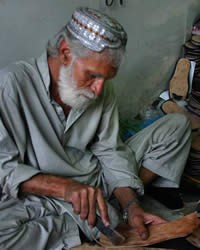

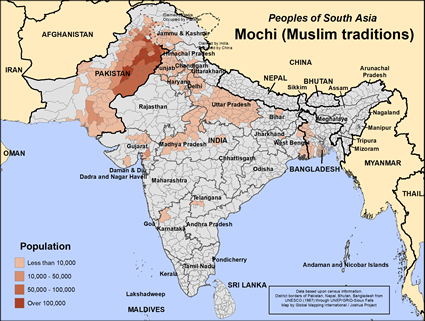
The Mochi are a Muslim artisan community found throughout Pakistan, especially in Punjab and Sindh. Traditionally, they have been associated with shoemaking, leatherworking, saddle making, and the production of other leather goods. The name "Mochi" is derived from words meaning "to fold" or shape leather, reflecting their long-standing role in transforming prepared hides into finished products such as shoes, harnesses, and saddlery. Historically, the Mochi worked alongside related leather-working communities, with some groups preparing hides while the Mochi specialized in crafting finished leather goods.
For generations, the Mochi occupied a socially disadvantaged position within South Asian society because occupations involving animal hides were often viewed as undesirable. This social stigma continued even after many communities embraced Islam and remains a challenge in some areas today. Traditionally concentrated in villages and market towns, many Mochi families depended on local landowners and agricultural communities for their livelihood. The spread of factory-produced footwear and manufactured goods has significantly reduced demand for traditional shoemaking, forcing many Mochi families to seek alternative forms of employment.
Today, while some Mochi continue their ancestral craft, many have transitioned into agricultural labor, construction work, small businesses, transportation services, and urban employment. Despite economic changes, community identity, family ties, and occupational heritage remain important aspects of Mochi culture.
Many Mochi families live in villages, small towns, and urban neighborhoods across Pakistan. While some still earn income through shoemaking and leather repair, others work as agricultural laborers, factory workers, mechanics, drivers, vendors, or construction laborers. The decline of traditional leather crafts has made economic stability difficult for many households, particularly in rural areas.
Family relationships are highly valued. Marriages are commonly arranged with significant family involvement, and extended families often maintain close connections. Community reputation and family honor play important roles in social life. In many areas, educational opportunities remain limited, contributing to ongoing economic challenges and restricting access to higher-paying professions.
Meals typically include flatbreads, rice, lentils, vegetables, tea, and locally available meat dishes. Religious festivals, weddings, and family gatherings serve as important occasions for strengthening community ties. Although modernization has improved opportunities for some younger Mochi, many families continue to face poverty, low literacy levels, and social marginalization.
The Mochi of Pakistan primarily follow Sunni Islam. They believe in Allah as the one true God and regard Muhammad as His final prophet. Religious life commonly includes daily prayers, fasting during Ramadan, giving charity, observing Islamic festivals, and participation in mosque activities. Islamic teachings shape many aspects of family life, morality, and community identity.
At the same time, some Mochi communities reflect influences from the broader South Asian religious environment. Folk practices, shrine visitation, use of amulets, fear of evil spirits, and other traditional beliefs may coexist alongside orthodox Islamic practices. This syncretism is common in parts of South Asia where cultural traditions have blended with religious observance over many generations.
Most Mochi are familiar with Isa (Jesus) as a prophet in Islam, but many have never encountered the biblical teaching that Jesus Christ is the Son of God who died for sinners and rose again to provide salvation through faith in Him. Access to Scripture, biblical teaching, and Christian discipleship remains extremely limited among many Mochi communities.
The Mochi face significant practical challenges, including limited educational opportunities, economic instability, social discrimination, and declining demand for traditional leather-working skills. Many families need improved access to education, vocational training, healthcare, and sustainable employment opportunities. The transition from traditional crafts to modern economic sectors remains difficult for many households.
Spiritually, the Mochi need opportunities to hear and understand the gospel in their own languages and cultural context. Many have never had access to clear biblical teaching about grace, forgiveness, repentance, and salvation through Jesus Christ. There is a need for culturally sensitive ministry, Scripture resources, long-term discipleship, and believers who are willing to build genuine relationships within Mochi communities. Existing Christians in Pakistan also need courage and wisdom to share the gospel faithfully with neighboring Muslim communities.
Pray that the Mochi people of Pakistan will hear a clear presentation of the gospel and come to know Jesus Christ as Savior and Lord.
Pray that God will raise up faithful believers who can build trusting relationships with Mochi families and disciple new followers of Christ.
Pray that Mochi communities facing poverty, limited educational opportunities, and economic hardship will experience practical help, dignity, and hope.
Pray that the Mochi people will be adopted through the People Group Adoption program so that ongoing prayer, evangelism, discipleship, and church planting efforts will continue among them.
Scripture Prayers for the Mochi (Muslim traditions) in Pakistan.
https://en.wikipedia.org/wiki/Mochi_(Muslim)
https://www.missioninfobank.org/mib/index.php?main_page=document_general_info&products_id=45167
https://unreachedoftheday.org/api/bulletin/download/en/08-09
https://en.wikipedia.org/wiki/Mochi_(Hindu)
https://www.islamicworld.it/wp/pakistan-blend-of-traditions-faiths-architectures/
| Profile Source: Joshua Project |



