



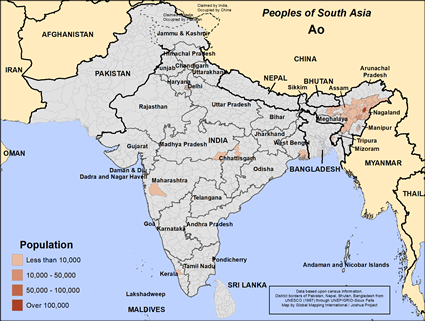
Nestled in the forested hills of Mokokchung District in Nagaland, Northeast India, the Ao are one of the most prominent Naga tribes in the region. Their name derives from their self-designation Aoer, meaning "those who came" — a reference to their ancestral migration from across the Dikhu River. Oral tradition traces their origins to a mythical site called Longterok, meaning "Six Stones," regarded as the sacred birthplace of the Ao people.
For centuries the Ao inhabited these rugged highlands as a warrior society, organized into village communities governed by councils known as the Putu Menden. Each village functioned as a largely self-sufficient unit, with social life structured around clan lineage, communal labor, and carefully observed rituals tied to the agricultural calendar. The morung, or men's dormitory, served as the center of education and community formation for young men, transmitting oral traditions, warrior codes, and cultural knowledge from one generation to the next.
The arrival of American Baptist missionary Edward Winter Clark in 1872 at the Ao village of Molungkimong set in motion a profound transformation. The Ao became the first Naga tribe to embrace Christianity, and with the faith came Western-style education. Clark Theological College, established in Mokokchung, became a training ground that sent Ao missionaries outward to other Naga peoples. As a result, the Ao have played an outsized role in spreading the gospel across Nagaland and beyond, earning Mokokchung a reputation as the intellectual and cultural capital of the Ao people.
Agriculture remains the foundation of Ao livelihood. Most families practice jhum, or shifting cultivation, on the hillsides, growing rice, maize, millet, and yams. The rhythm of the farming year — clearing, burning, sowing, and harvesting — shapes not only the economy but the social calendar. Pork, various greens, and fermented foods are dietary staples, often shared communally during celebrations.
Family life is organized along strong clan lines, with elders commanding deep respect. Village councils continue to exercise authority in local governance, and communal participation in decision-making remains valued. Women are central to both agricultural work and the preservation of craft traditions, particularly handloom weaving. Ao women produce distinctive shawls and skirts with intricate patterns that carry clan and village identity.
The Ao celebrate two major festivals that anchor community life. Moatsu Mong, observed in early May after the sowing season, is a three-day festival of rest, thanksgiving, and communal bonding. Families gather around large bonfires in the Sangpangtu ceremony, feasting on pork and rice, singing warrior songs, and renewing friendships. The harvest festival of Tsüngremmong follows later in the year, marking the close of the agricultural cycle with equally enthusiastic celebration. Christmas and New Year are also major occasions, with churches hosting music events and the town of Mokokchung coming alive with decorations and fellowship.
Before the coming of Christianity, the Ao held a deeply animistic worldview, placing their trust in a world populated by spirits called tsüngrem. These spirits inhabited the sky, the earth, house sites, rivers, and forests, and people directed offerings and sacrifices toward them in order to secure protection, fertility, and prosperity. Above them all stood Lichaba, creator of the earth, whose favor was sought through ritual and ceremony. The belief in a "Land of the Dead" — whether in the sky or beneath a distant hill — shaped how the Ao understood life, death, and the unseen world around them.
The encounter with the gospel proved transformative for most Ao people. Today, Christianity — particularly in its Baptist expression — is the dominant faith of the Ao, and the church occupies a central place in community life. Churches are gathering places, educational institutions, and social anchors. Many Ao Christians carry their faith with genuine conviction, and the community has produced pastors, theologians, and missionaries who serve throughout India and abroad.
Nevertheless, traditional spiritual practices and worldviews persist alongside Christian profession, and not every Ao person has a living, saving faith in Jesus Christ. The opportunity for deeper discipleship and genuine transformation remains real. Salvation and eternal life are found only in Jesus Christ, and prayer for the Ao should include that those who bear the name Christian would know him personally and walk in the fullness of the gospel.
Mokokchung District faces the infrastructure challenges common to remote, hilly regions of Northeast India, including limited road connectivity, inconsistent access to healthcare, and economic constraints that push educated young Ao away from their villages and into larger urban centers. The migration of youth to cities creates a generational gap in villages, leaving elders without support and traditional knowledge at risk of being lost. Though literacy rates among the Ao are relatively high compared to many other Indian tribal groups — a legacy of missionary education — rural communities still struggle with access to quality healthcare and economic opportunity.
Spiritually, the Ao stand in a unique position: a largely Christian community with both a rich gospel heritage and the challenge of nominalism. Many need to move from religious identity to genuine, personal faith. Beyond their own community, the Ao have neighbors and fellow Indians from other religious backgrounds who have little access to the gospel. The Ao church has both the witness and the responsibility to carry Christ's name to those communities.
Pray that Ao believers would move beyond nominal Christianity into a deep, living relationship with Jesus Christ.
Pray that the Ao church would be bold in sharing the gospel with neighboring peoples and unreached communities throughout India.
Pray for improved healthcare and economic opportunities in rural Mokokchung District, especially for the elderly and those left behind by youth migration.
Pray that Ao pastors and theologians would be raised up with wisdom to disciple their communities in the full truth of Scripture.
Scripture Prayers for the Ao in India.
https://en.wikipedia.org/wiki/Ao_Naga
https://neiipa.in/ao/
https://mokokchung.nic.in/culture-heritage/
https://bharatarticles.com/moatsu-festival-2025-ao-naga-culture-and-heritage/
https://humansofnortheast.com/mokokchung-a-cultural-hub-of-the-ao-naga-tribe/
https://journal.fac.ac.in/Journal/2016/01-FACJ-6-2016.pdf
https://www.researchgate.net/publication/336776848_The_Impact_of_Christianity_and_Cultural_Traditions_of_Ao-Naga_Tribe_in_Nagaland
| Profile Source: Joshua Project |



